


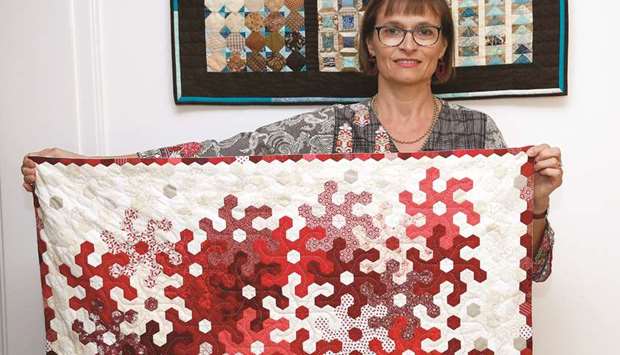
Virginie Leduc Kestrel is a patchwork artist from France. She has recently moved to Qatar and been a part of Doha Patchwork Association. She has been offering lessons to those who are interested in learning the work.
Community recently caught up with Virginie to discern about her life and work. Excerpts from the interview.
Please tell us briefly about yourself.
I am a French expatriate living with my husband, who works in the gas sector. I have been doing patchwork for 25 years and learnt it in Paris. I have been a part of different groups because usually patchwork is a group activity.
As I travelled with my husband in different countries, I started to teach with stints in Nigeria, Norway, France and now, Qatar. I have been in Qatar for one and a half years. I have three boys and they all live in Paris. I have a university degree in business and earlier worked for 10 years as a marketing manager.
How would you best explain patchwork?
It is a technique having a lot of fabric pieces and sewing them together to create a pattern. There are different techniques in which you can assemble the patches. You can make either geometrical patterns or whatever you like.
It is a very old technique. Later, I went to the US where it became very popular.
Traditionally, only cotton was used for the patchworks with very small prints. Then, there was an evolution in the fashion of patchwork. Now, we have started to have very huge patterns. Further, in the new fashion, people are also working with wool. However, we cannot make very thin patterns with the wool. We also use different embroidery threads. The best ones are hand dyed.
When did you start taking interest in the work?
Once I went to a very old house in Normandy, in northern France, with my family. I think it was in 1991. There was an old woman. She had been living in US. Her house was full of wonderful quilts. I never saw them before. That day I fell in love with patchwork quilting.
I got an opportunity to learn the art and never stopped. I learnt it at Pau in southern France. I got free lessons from the people who master and love the art. The spirit of patchwork is sharing. In a year, I learnt most of it. After that it has only been a matter of practising.
What extraordinary patterns have you created so far?
Most of my work has been shown in different exhibitions in Paris and Pau. I am a part of a club in Paris where we have quilt shows every three years.
One of the most difficult things I have ever made I think is goutis, a French patchwork technique. Earlier, I just used to prepare traditional patchwork designs. Now, I am trying to cover contemporary designs that are in fashion today. I also use different geometrical designs to make my patchworks more attractive and symmetrical. I also use kaleidoscope to make my patterns more attractive and beautiful.
Please tell us about the experience of teaching patchworks.
As I said earlier, I have been teaching in different countries. In Qatar, I have been advertising in different groups, inviting people to my residence if they are interested in learning patchwork. I teach free of charge. It is a spirit of sharing the knowledge. It is very pleasing to see other people learning the technique and becoming creative.
Largely, patchwork has been a traditional kind of work. The knowledge has been coming from grandmother to mother. With the passage of time, people are becoming creative and bringing in more designs and patterns.
I think in Japan, they are beginning to have specific schools for quilting. It is a very nice thing. They are really very good at it. I think Japan is the only place in the world where they are doing it academically.
How do you see the future of patchwork in France?
With Internet, everything has become worldwide. We can take inspiration from any place. Earlier, the patchwork was used for bed, pillow, cushion and quilt layers. Now, we have started to put them on walls as art pieces.
The trend of patchwork is alive in many countries. The current trend of patchwork came back to France from the US.
Most retiring people have plenty of time on their hands. Usually, they learn patchwork. The art has its future as we can see it on quilts, beds and now on walls.
What advice will you share with young people interested in the art?
I will say that they should join a group of patchwork artists. You need to be very precise. I love miniature in patchwork. It is very tiny work and you must be very accurate. You have to be honest with your work because is not very easy.
What have you been doing in Qatar so far?
I am a part of Welcome Doha, a French group. On this platform, I proposed to teach patchwork and have been since January this year. I am also the part of an international group where there are many women from Qatar. We all have been sewing same kinds of designs and patterns, mostly coming from US. Living in Qatar, gives me a lot of time to carry on doing my work.
Do you enjoy living here?
Well, Qatar is a nice place. We can live here as we wish. You can go wherever you want to. It is very secure and peaceful here. People are very friendly. I have a lot of friends here. Qatar is very diverse. It is really good to see people coming from all parts of the world here.