


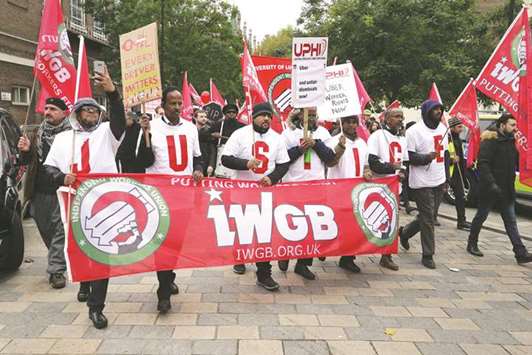
Hundreds rallied outside the court in what is being billed as Britain’s biggest ever precarious workers march as the taxi-hailing app company argued that an employment tribunal ruling that Uber drivers were “workers” ignored the fact that the relationship between the company and its drivers was “typical of the private hire industry”.
Dinah Rose QC, for Uber, told the court of appeal in central London that “the agency model” – with Uber acting as an agent between drivers and passengers – had been used in the private hire industry “for many years”.
It was not “unusual” because of the relationship between it and its drivers, “but because the Uber app enables it to operate on a much larger scale than traditional minicab companies”.
Those in a packed courtroom included drivers James Farrar and Yaseen Aslam, who won an employment tribunal in 2016 after arguing they should be classified as workers, citing Uber’s control over their working conditions.
Uber subsequently mounted an appeal at the tribunal level, warning that it could deprive riders of the “personal flexibility they value” but last November failed to overturn the ruling that its drivers should be classed as workers with the right to earn a minimum wage.
The court of appeal was told by Uber’s counsel how the Internet had revolutionised many traditional businesses in a number of ways, including by allowing existing entities to operate with “vastly expanded scope”.
What was special about Uber was the software that allowed for the tracking of the location of a passenger and a driver who had its app switched on, said Rose, who described this as a “critical innovation”.
She argued however that the nature of Uber’s business was no different to that conducted by other private hire companies who make money from the commission paid by drivers on fares.
“Uber’s app is its asset and it is an enormously valuable piece of software,” she told the three judges in a submission which, at one point, compared Uber drivers to barristers and the company to clerks.
Uber had a “powerful commercial interest” when it granted licences to people to use its app and in the setting of conditions on its use, she added.
There was “nothing strange or unusual or morally unconscionable” in a company that owned very valuable assets seeking to use it in that way.
Jason Galbraith-Marten QC, for Aslam and Farrar, said there was “no express agreement” by which the claimants appointed Uber “to act as their agent and setting out the nature and extent of that agency”.
The tribunals’ task was therefore to “determine the true nature of the (implied) agreement” between drivers and Uber, he added.
Galbraith-Marten said the tribunals were “entitled to ask whether the claimants are genuinely in business on their own account” or whether they were “providing their services” to Uber.
If Uber was not acting as the drivers’ agent, “the purported driver-passenger contract is indeed a fiction”.
Earlier, a demonstration organised in support of Aslam and Farrar was told by Frank Field, the chair of the House of Commons work and pensions committee, that Uber were “rich enough to put themselves above the law”.