


Following his talks with Xi Jinping in China, Abe received Modi at a resort at the foot of Mount Fuji, the country’s highest peak.
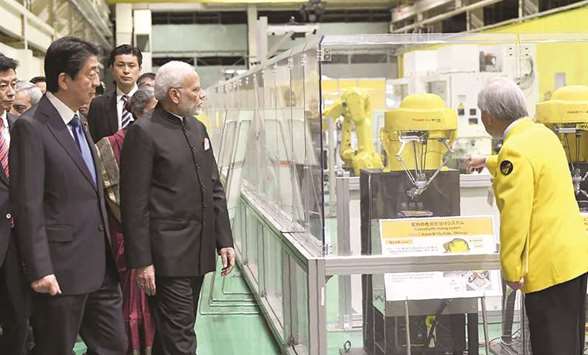
After visiting a factory operated by robot manufacturer Fanuc in the prefecture of Yamanashi, Modi had the honour of being the first foreign head of government to be invited to Abe’s vacation home near the mountain.
Modi was briefed on the various robotic and automation capabilities of Fanuc.
Both leaders observed several illustrations of the working of industrial robots. At the motor assembly facility, they witnessed the assembling of a motor by a robot in 40 seconds.
Fanuc contributes to the manufacturing industry in Japan and other countries, including India, by promoting automation and efficiency in manufacturing.
Both leaders spent around eight hours together during the course of the day.
Modi gifted his Japanese counterpart two handcrafted stone bowls and durries.
According to sources, the bowls, made from rose quartz and yellow quartz stone sourced from Rajasthan, were crafted by master artisan Shabbirhusen Ibrahimbhai Shaikh of Khambhat region of Gujarat.
The uniqueness of this craft lies in the fact that the form of the product is scooped out from a block of stone and then shaped and refined using basic hand tools generally without any lathe machines.
Hand-woven by the master weavers of Mirzapur, Uttar Pradesh, the durrie designs show the diversity of possibilities - from a symmetrical repeating geometric tessellation in one, to stylistic floral motifs arranged around the classical medallion pattern in another.
The durries use two distinctive Indian colour palettes. While one uses indigo blues, reds and a sprinkling of turmeric yellows, the identifying colours that have marked Indian textiles for centuries, the other uses the muted earthy tones of the Indian landscape.
Modi also gifted a Jodhpuri wooden chest from Rajasthan with traditional work.
The two leaders are scheduled to hold formal talks in Tokyo today that will likely touch on China’s growing power in the region.
They are expected to issue a joint communique on strengthening security co-operation and measures aimed at pursuing a “free and open Indo-Pacific,” Kyodo News agency reported, citing an unnamed Foreign Ministry official.
Their statement is expected to include improved co-operation between the two countries and the United States, which is designed to counter China’s expansion in the South China Sea.
Modi and Abe are also likely to agree to expand the two countries’ co-operation in the medical field and boost exchanges in various areas.
“(We) will have a frank exchange of views and I’d like to deepen our co-operative ties for peace and prosperity in the Indo-Pacific region,” Abe said at a meeting of his Liberal Democratic Party on Tuesday.
This is Modi’s third visit to Japan as premier. The two leaders met in Japan in November 2016 last time. They have regular mutual visits.