


The European Union has slammed “undue” restrictions on freedom of expression during Pakistan’s election season this summer in a report released on Friday, saying that the crackdown led to considerable self-censorship of the media.
There were widespread claims in the months leading up to the July 25 vote that the powerful military was trying to fix the playing field in Imran Khan’s favour.
The army and Khan, a former cricketer who captained Pakistan to World Cup victory in 1992, have denied the claims.
“Comprehensive analysis of the media’s output, however, reveals that editorial policies were carefully calibrated to downplay issues relating to the army, state security structures and the judiciary,” said the EU Election Observation Mission’s final report on the July polls.
The monitors also said that during the campaign season, senior editors received “intimidating phone calls”, while also noting curbs on the distribution of “broadcast and print outlets, and harassment of individual journalists”.
“In such an environment, severe self-censorship was the safest option to continue publication” the report said.
The EU report also noted constraints on freedom of assembly during the period along with the presence of armed forces inside polling stations.
The report called for increased transparency in electoral processes and a review of election rules.
However, the monitors downplayed opposition allegations of election-day malfeasance, saying that a days-long delay in the delivery of official results was caused by technical failures.
Khan and his Pakistan Tehreek-e-Insaf (PTI) party won the election but fell short of an outright majority, forcing him to partner with smaller parties and independents in order to form a government.
He campaigned on promises to end widespread graft while building an “Islamic welfare state”.
The EU made a list of 30 recommendations to improve the quality, legitimacy and credibility of future general elections.
According to the report released on Friday, Pakistan should undertake all these 30 recommendations but suggests priority attention should be given to the following eight:
1 – Review the Constitution and Election Act so that any restrictions imposed on the right to stand as a candidate are not subject to vague, moral and arbitrary criteria.
2 – Revise the Election Act, Election Rules and Codes of Conduct to ensure robust mechanisms for transparency of the Election Commission of Pakistan (ECP). These would include specific timeframes for, and the manner of, dissemination of information of public interest, including online.
3 – To contribute to public confidence in the ECP, the Commission should introduce a range of measures to increase transparency, such as the holding of regular meetings with election stakeholders.
4 – Guarantee civilian ownership of the conduct of elections by limiting the presence of security forces to outside polling stations only.
5 – Review the legal framework for the media, including for online content, to ensure compliance with international standards for freedom of expression.
6 – Introduce affirmative measures to foster the representation of women contesting general seats.
7 – Adopt a unified electoral roll by removing the requirement for any supplementary list of voters, so that all citizens can be registered to vote on an equal basis in accordance with international standards.
8 – Establish in law the right to national and international observation, ensuring full access for observers, including media representatives, to all stages of the electoral process.
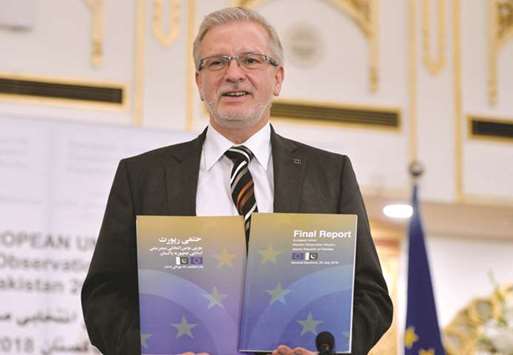
Michael Gahler, chief observer of the European Union Election Observation Mission (EUEOM), displays copies of the final report of Pakistan’s general election 2018 during the news conference in Islamabad.