


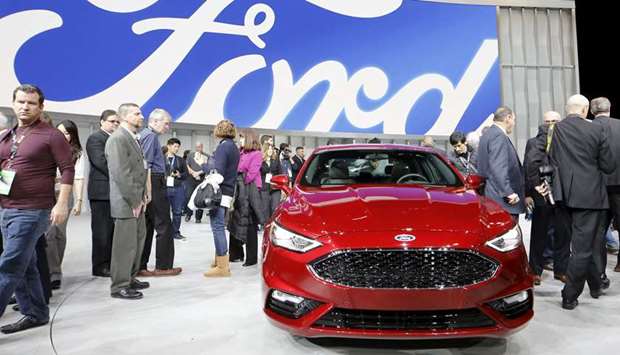
Ford Motor Co on Wednesday reported slightly higher than expected third-quarter profit and stuck to its targets for the year, raising investor hopes for a strong fourth quarter and sending its shares up as much as 7% after-hours.
Profit was down as high commodity costs and a China sales slump partially offset strong demand for high-margin pickup trucks and sport-utility vehicles in North America.
The No 2 US automaker maintained its full-year earnings forecast.
Last quarter, Ford announced a pending restructuring that could lead to pretax charges of up to $11bn.
On Wednesday, chief financial officer Bob Shanks said that plan remains in place.
But the CFO said while Ford is still committed to an overall pretax margin target of 8%, the company will not hit it by 2020 as previously announced.
Some investors and analysts have been frustrated by a lack of details about the restructuring and Shanks said the company still has nothing to announce at this time.
Ford’s vehicle sales in China, where Ford lost $378mn in the quarter, fell 43% in September from a year earlier and are down 30% in the first nine months of the year.
Ford said it managed a North American third-quarter pretax margin of 8.8%. The company reported a third-quarter net profit of $993mn, or 25 cents per share, a 36% drop from $1.6bn or 39 cents per share in the year earlier quarter.
Excluding one-time items, Ford earned 29 cents per share in the quarter, 1 cent above average analyst estimates, according to Refinitiv.
Revenue for the quarter rose to $37.7bn from $36.5bn a year earlier.
Analysts had expected $33.3bn.
The company said it still expects full-year earnings per share in a range of $1.30 to $1.50, indicating it sees a fourth-quarter profit in the range of 31 to 51 cents a share.
Analysts expect a fourth-quarter profit of 31 cents.
Ford shares rose as much as 7% in trading after the closing bell.
They had closed at a 9-year low on Wednesday of $8.18.
Hyundai Motor
Hyundai Motor reported a 67% plunge in third-quarter net profit from the previous year after overseas sales slowed and currency swings hurt its bottom line in emerging markets.
Net profit for July to September was 306bn won ($268.8mn), while operating profit plummeted 76% year-on-year to 288.9bn won, the firm said in a statement.
“The third quarter was a difficult time due to slowing demand in major markets including the US and concerns over a global trade dispute,” said Hyundai, which together with its subsidiary Kia is the world’s fifth-largest automaker.
Weakening of the Brazilian and Russian currencies and slowing sales in China also took a toll on Hyundai’s bottom line, it said, noting that the Brazilian real lost more than 20% against the won in the last 12 months.
The company sold 1.12mn cars worldwide in the third quarter, down 0.5% from the same period last year.
It has struggled to stay afloat in China — the world’s largest car market — as it is increasingly sandwiched between high-end cars from Japan and Germany and cheaper vehicles from homegrown carmakers.
Sales were further hurt by the company’s late foray into the Chinese market for sports utility vehicles (SUVs), which have risen in popularity among Chinese consumers.
Union Pacific
Union Pacific Corp yesterday posted a bigger-than-expected jump in quarterly profit and said it was working to run its trains more efficiently as new US trade policies and economic softening in Europe threaten to slow business down.
A strong economy, robust freight demand and a tight US trucking market have buoyed the railroad sector, which reaped outsized benefits from President Donald Trump’s 2017 tax cuts.
Union Pacific’s third-quarter net income jumped 33% to $1.59bn, or $2.15 per share, 5 cents more than analysts had expected, according to Refinitiv data.
Revenue rose 9.6% to $5.93bn in the latest quarter.
Its operating ratio, a closely watched measure of operating expenses as a percentage of revenue, was flat at 61.7%, due in part to costs for crews who run trains.
On October 1 it rolled out a “Precision Scheduled Railroading” plan to improve efficiency and ease network congestion. On Tuesday it announced job cuts, business consolidations and plans to sell a corporate retreat.
Husky Energy
Canadian oil and gas producer Husky Energy Inc reported a bigger third quarter profit yesterday, topping expectations with a boost from higher crude oil prices.
Production decreased to 297mn barrels of oil equivalent per day (boe/d) from 318mn boe/d in the same quarter last year.
Net income rose to C$545mn ($418.27mn) from C$136mn a year earlier.
Adjusted for one-time items, earnings amounted to C$568mn or 57 Canadian cents per share, up from C$136mn and 14 Canadian cents per share.
Twitter
Twitter Inc shares jumped as much as 22% yesterday, putting them on track for their biggest one-day gain, as the social media company easily beat Wall Street’s revenue and profit estimates by selling more ads even though it lost users after purging millions of fake accounts.
The surge in shares reversed a 19% fall three months ago when Twitter shocked Wall Street with a similar decline in users.
This time, investors welcomed Twitter removing accounts used for disinformation, hate speech and other abuse as the best way to solidify a base of high-quality users who are attractive to advertisers.
Twitter’s advertising revenue jumped 29% to $650mn in the third quarter from a year earlier, boosted by ad sales on broadcasts from media companies including Live Nation Entertainment, Major League Baseball and Major League Soccer.
That contributed to a similar jump in overall revenue from a year earlier to $758mn, beating analysts’ average estimate of $702.6mn, according to Refinitiv data.
The company reported adjusted profit of 21 cents per share, well above the average estimate of 14 cents.
Monthly active users (MAUs) fell to 326mn in the third quarter, below the average analyst forecast of 331.5mn, according to FactSet.
Distribution deals with US Major League Baseball, video game publisher Activision, Sony Music and Vice are starting to lure advertisers to Twitter’s live premium video, he said.
Twitter said the number of its daily active users rose by 9% year-on-year, weaker than an 11% jump in the previous quarter and its slowest growth rate in two years.
The company does not disclose the total number of daily users.
They are still down about 42% from their 3-1/2 year high of $47.79, hit in June.
Raytheon
Defence contractor Raytheon Co beat analysts’ estimates for third-quarter profit yesterday and raised its full-year forecast, helped by sales of Patriot missile defence systems and cybersecurity services.
Chief financial officer Toby O’Brien told Reuters in an interview yesterday that 2019 sales are expected to grow by 6% to 8%. Wall Street analysts are expecting 6%, according to Refinitiv data.
During the third quarter, O’Brien told Reuters the company had a negative 0.8% tax rate because of one-time research and development credits and planned pension fund contributions.
He said the tax rate for the year would be about 10.5%, with next year’s tax rate in the range of 17% to 19%.During an earnings conference call with analysts, O’Brien said Raytheon could look at “options” for its commercial cybersecurity unit, Forcepoint.
Income from continuing operations attributable to the company rose 12.4% to $644mn, or $2.25 per share, in the third quarter, beating Refinitiv estimates of $1.98.
Overall sales rose 8.3% to $6.81bn, topping estimates for $6.70bn.
Raytheon’s order backlog increased by 13% in the quarter to $41.6bn.
Merck, Bristol-Myers Squibb
Merck & Co Inc and Bristol-Myers Squibb Co posted better-than-expected third quarter profit and raised their 2018 earnings forecasts yesterday due to strong demand for their rival cancer immuno-oncology treatments.
But shares of both US drug makers fell as investors worry about a plan the Trump administration is expected to unveil yesterday aimed at lowering prices the government’s Medicare healthcare programme pays for specialty drugs like cancer treatments.
Merck reported adjusted earnings of $1.19 per share, beating analysts’ average estimate by 5 cents, according to Refinitiv data. Revenue rose 4.5% to $10.79bn, falling short of Wall Street expectations of $10.88bn.
The company also announced a $10bn share buyback and raised its quarterly dividend by 15%.
Bristol-Myers’ said it earned $1.09 a share, excluding special items, topping analysts’ average expectations by 18 cents.
Revenue rose 8% to $5.69bn, just shy of Wall Street estimates of $5.72bn.
Sales of blood clot preventer Eliquis, which Bristol shares with Pfizer Inc, rose 28% from last year to $1.58bn, but fell short of analyst expectations of $1.67bn.
Bristol-Myers’ effective tax rate was 11.8% in the quarter.
Shaw Communications
Canada’s Shaw Communications Inc’s quarterly profit yesterday topped analysts’ estimates as the telecom services provider added more customers to its wireless offerings.
The Calgary-based telecom services provider said its net additions for wireless subscribers more than doubled to 85,000 in the fourth quarter.
The company’s net income fell to C$200mn ($153.29mn), or 39 Canadian cents per share, in the quarter ended Aug.31, from C$481mn, or 96 Canadian cents a share, a year earlier.
Shaw Communications said it had an additional C$16mn restructuring charge in the quarter.
Revenue rose to C$1.34bn from C$1.24bn.
Excluding items, Shaw Communications earned 42 Canadian cents per share, against average analysts’ estimate of 36 Canadian cents per share on a revenue of C$1.35bn, according to data from Refinitiv.
Hershey
Chocolate maker Hershey Co reported a fall in quarterly profit yesterday as investments in packaging and higher freight costs added to expenses, sending its shares down 5%. Gross margin — a measure of how much profit a company can make on every dollar spent — fell 490 basis points to 41.5%.
Net income attributable to Hershey fell to $263.71mn in the third quarter ended September 30 from $273.30mn a year earlier.
Excluding items, the company earned $1.55 per share, in line with analysts’ average estimate, according to Refinitv data.
Sales rose 2.3% to $2.08bn but fell short of the average analyst estimate of $2.09bn.
Sales in North America, its biggest market, rose 2.9% to $1.84bn, while sales in international markets fell 1.9% to $236.1mn.
Hershey’s shares have fallen 5% this year, compared with a 4.2% loss for the broader S&P Consumer Staples index.
Union Pacific
Union Pacific Corp, the No 1 US railroad, topped quarterly Wall Street estimates for profit yesterday, as it transported more industrial and agricultural products.
A strong economy, robust freight demand and a tight trucking market in the United States have buoyed the sector, with railroads also benefiting from President Donald Trump’s 2017 tax cuts.
The company’s freight revenue rose 10.1% in the third quarter.
Freight revenue from industrial products, which include construction products and lumber, rose 13.1%, while revenue from agricultural products increased 6%. Union Pacific said its operating ratio, a closely watched measure of operating expenses as a percentage of revenue and a key metric for Wall Street, was flat at 61.7%. The company aims to reduce its operating ratio to at least 60% by the end of 2020.
A lower operating ratio means more efficiency and higher profitability.
The company’s net income jumped 33% to $1.59bn, or $2.15 per share, in the quarter ended September 30.
Analysts on average had expected a profit of $2.10 per share, according to Refinitiv data.
Revenue rose 9.6% to $5.93bn.
American Airlines
American Airlines reported yesterday a drop in third-quarter earnings on higher fuel prices, although strong demand for air travel boosted revenues.
Profits for the quarter ending September 30 were $341mn, down 48.4%. Revenues rose 5.4% to $11.6bn.
Chief executive Doug Parker said higher fuel prices lifted expenses by about $750mn compared with the year-ago period.
American announced previously that in response to higher fuel prices, it was trimming $1.2bn in capital spending over the next three years by deferring delivery of 22 Airbus planes.
The airline has also been tweaking its “basic economy” programme by easing carry-on bag restrictions and expanding its “premium economy” offering on more flights.
Airlines have introduced a range of seat offerings at different price points as a way to compete with bare-bones carriers and boost ticket prices.
CME Group
CME Group’s quarterly profit beat analysts’ estimates yesterday, as the exchange operator benefited from a US corporate tax cut and earned more from providing market data services to clients.
Revenue from the company’s market data and information services business, which help investors make trading decisions and minimise risk, rose 14.2% to $110.7mn.
Like other exchange operators, CME has been increasingly trying to build its non-trading related businesses in a bid to reduce its dependence on market fluctuations.
The Chicago-based exchange operator’s income tax provision halved to $150mn.
US companies have been reaping the benefits of a corporate tax cut enacted by the Donald Trump administration.
Net income rose to $411.8mn, or $1.21 per share, in the third quarter ended September
30, from $308.6mn, or $0.91 per share, a year earlier.
On an adjusted basis, the company earned $1.45 per share, beating Refinitiv estimates of $1.43.
Clearing and transaction fee revenue fell 0.5% to $752.5mn and average daily volumes fell 0.8%.
Yes Bank
India’s Yes Bank Ltd missed second-quarter profit estimates by a wide berth yesterday as provisions for bad loans and mark-to-market losses more than doubled, exacerbating woes at the bank in search of a new CEO.
Net profit came in at 9.65bn rupees ($132mn) in the quarter ended September 30, compared with 10.03bn rupees a year earlier and short of analysts’ average estimate of 12.82bn rupees, according to I/B/E/S data from Refinitiv.
Provisions, or the amount set aside to cover a future liability, surged 110% to Rs9.40bn.
The results come as Yes Bank looks for a new chief executive by the February 1 deadline imposed by India’s central bank, which last month denied CEO Rana Kapoor an extension of his term with the firm he founded.
The Reserve Bank of India (RBI) did not give a reason for the decision, which sent Yes Bank shares plummeting.
Market participants said the move represented the central bank’s new hard-line approach in reducing the bad debt plaguing India’s banking sector.
Yes Bank’s gross bad loans as a percentage of its total loans stood at 1.60% by the end of September, compared with 1.31% a quarter earlier and 1.82% a year earlier.
Yes Bank shares closed 2.8% lower ahead of the results.
Southwest Airlines
Southwest Airlines Co posted a forecast-beating rise in quarterly profit yesterday and said it would expand margins next year, when it plans to add flights to Hawaii, thanks to a healthy revenue outlook.
The fourth-largest US airline by passenger traffic said net income rose to a record $615mn, or $1.08 per share, in the third quarter to September 30 from a year ago, beating a Wall Street consensus forecast of $1.06.
Total operating revenues rose 5.1% year-on-year to $5.57bn, also a record for the quarter.
Fourth-quarter unit revenue — a closely watched performance measure that compares sales to flight capacity — to rise one to 2%. Dallas-based Southwest, which has built a reputation for offering lower fares than its rivals and not charging bag or change fees, said it still planned to increase capacity by no more than five% next year.
Despite a rise in global travel demand, airlines are trying to avoid adding too many seats to a competitive market, particularly as high fuel prices eat into profits.
Southwest’s fuel cost rose 16.2% during the quarter.
Daimler
German car giant Daimler reported yesterday a slump in third-quarter profits, confirming a weaker 2018 outlook as it suffered lower sales and shouldered costs for refits to polluting diesel cars.
Net profit at the Mercedes-Benz maker shed 21% year-on-year between July and September, to €1.76bn ($2.0bn), short of analysts’ forecasts.
Operating, or underlying profits were even harder hit, falling 27% to €2.5bn, while revenues were down 1.0% at 40.2bn.
There was a brighter picture at Daimler’s other major unit, Daimler trucks, which revved up operating profit 38%. Looking ahead, Daimler confirmed its full-year outlook issued last week of a group-wide operating profit “significantly lower” than 2017’s €14.7bn.
Nokia
Finnish telecoms equipment maker Nokia reported a reduction in its third-quarter losses of almost 57% yesterday, as it launched a cost-savings programme in a bid to restore profitability.
The company announced a net loss of €79mn between July and September, compared to €183mn for the same period last year.
Nokia also released details of a €700mn cost-savings programme between now and the end of 2020, of which 500mn is expected to come from operating expenses.
The improved results, driven by a pickup in commercial 5G deployments in the US, saw Nokia reiterate its guidance to investors after a difficult start to the year.
In a statement Nokia said its €700mn savings programme will look to cut costs through a wide range of measures.
These include further investment in digitisation “to drive more automation and productivity”, and “significant reductions in central support functions”. The group’s turnover fell 1.0% in the third quarter to €5.46bn, due to unfavourable exchange rates, but Nokia reduced its operating loss from €230mn to 54mn.
Nokia’s share price rose 0.5% on the opening of the Helsinki stock exchange following publication of the results.
Puma
German sportswear firm Puma raised its outlook for full-year sales and operating profit yesterday as it reported strong sales growth in the Americas and Asia and said its first basketball shoe in 20 years had been well received.
This is the second time this year that Puma is raising its full year outlook and the news kicked its shares up 9% in early trade.
Puma said it now expects that currency-adjusted sales for 2018 will rise between 14 and 16%, up from a previous 12 to 14%. Operating profit will come in at 325mn to 335mn, up from a previous target range of 310mn to 330mn, Puma added.
Puma saw third-quarter sales rise almost 16% in the Americas in the quarter and 23% in Asia, even as concerns grow that a trade war between Beijing and Washington will curb spending by Chinese shoppers.
Third quarter sales rose a currency-adjusted 14% to €1.242bn ($1.42bn), while operating profit was up 28% to 130mn, beating average analyst forecasts for 1.2bn and 119mn respectively.
Anheuser-Busch InBev
Anheuser-Busch InBev cut its proposed dividend by half yesterday as beer sales dropped in the world’s largest brewer’s largest markets, the United States and Brazil, and overall earnings fell short of forecasts, knocking its shares.
AB InBev’s shares fell by 7.6% to €66.89 and were among the weakest in the FTSEurofirst index after the brewer of Budweiser, Stella Artois and Corona said it will pay a total dividend of €1.80 per share for 2018.
This would save AB InBev, which paid around $100bn for SABMiller in 2016, about $4bn which the Belgium-based brewer said would be used to cut its net debt of $108.8bn.
Third-quarter core profit (EBITDA) rose 7.5% on a like-for-like basis to $5.36bn, well below the average forecast in a Reuters poll of $5.71bn.
Earnings per share, at $0.82 was also below the average expectation of $1.03.
Lloyds
Britain’s Lloyds Banking Group shrugged off fears of a chaotic, no-deal Brexit and pledged to keep pumping credit into the economy regardless of the outcome of negotiations between Brussels and London.
Lloyds shares remained flat at the market open after it reported a third-quarter pretax profit of £1.8bn ($2.32bn), outperforming the £1.7bn average from company-compiled analyst estimates.
It was helped by a growing net interest margin — a key measure of bank profitability — and falling costs.
The net interest margin rose 8 basis points to 2.93%. Lloyds also said it had grown its lending to small businesses and in higher-margin areas such as car finance — two strategic aims laid out in the three-year plan laid out in February.
The bank aims to digitise operations and grow outside of core markets such as mortgages, where it has effectively exhausted opportunities for significant growth.
Another key ambition is an increased presence in insurance and wealth, where the bank has secured two partnerships in recent weeks.
The bank reported a core capital ratio of 15.5%, up from 14.9% a year ago, reflecting continued efforts to make its balance sheet recession-proof.
UBS
Swiss banking giant UBS reported yesterday better-than-expected third quarter results alongside a cautious outlook due to current turmoil in the markets.
UBS said its net profit in the three months to September jumped 32% from a year earlier to 1.2bn Swiss francs (€1.0bn, $1.2bn), boosted by its asset management unit.
Analysts had forecast a net profit of 995mn Swiss francs.
Revenues came in as expected at 7.2bn Swiss francs, up 2.0%. UBS maintained its current year-end estimates on the basis that current global growth rates still offered business opportunities.
At the same time, the bank highlighted concerns over persistent geopolitical tensions plus trade conflicts which have dented investor confidence, especially at its asset management arm.
This unit, the bank’s biggest, posted a pretax profit gain of 3.0% to 932mn Swiss francs.
Tesla
Tesla Inc shares jumped yesterday as Wall Street analysts said the company had turned a corner with profitable third quarter results and might not now need to raise outside capital.
Rising 12% at one point in early trading, the move in shares added as much as $6bn to Tesla’s market value, capping a tumultuous few months for the company and its billionaire chief executive, Elon Musk.
Tesla shares hit a record in August but sank back as Musk was sued by short-sellers and US regulators for tweeting, and then swiftly abandoning, a plan to take the company private.
Tesla reported free cash flow of $881mn in the quarter — the first time since the third quarter of fiscal 2016 — and Musk said the company will maintain that in the coming quarters.
Musk has been saying since May that Tesla does not plan to raise equity or debt.
The yield on Tesla’s $1.8bn high-yield bond due in August 2025 dropped to a two-month low as the debt rallied off the quarterly results.
Since Monday, the yield on the bond, which sports a 5.3% coupon, has dropped more than 90 basis points to 7.49% from 8.40%. Tesla reported profit of $311.5mn, or $1.75 per share, for the third quarter ended September 30, compared with a loss of $619.4mn, or $3.70 per share, a year earlier.
Ford