


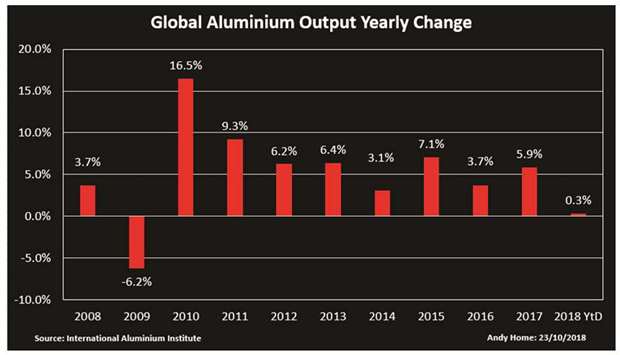
Global aluminium production growth has ground to a halt this year. Cumulative production grew by just 0.3% in the first nine months, the slowest rate of expansion since the Global Financial Crisis (GFC) in 2008-2009.
Smelter outages in Canada and Brazil continue to constrain run rates in the Western World, while structural reform in China is capping output in the world’s largest aluminium producing nation.
In theory, the potential exists for a re-acceleration in growth in both China and the rest of the world.
In practice, however, a squeeze on availability of alumina, the raw material used to make aluminium, is compressing smelter margins with the rising threat of more production hits.
Aluminium output in the world outside of China grew by 1.9% in Jan-Sep 2018, according to the International Aluminium Institute (IAI). Asia (excluding China) is the region with the fastest production growth at 14.0% so far this year largely thanks to the ramp-up of new capacity in India.
Vedanta Resources reported record production of 494,000 tonnes in Q3, up 23% year-on-year, as the company’s Jharsuguda II plant builds up towards its 1.25mn tonne-per-year capacity.
The plant’s third line was operating 303 out of 336 pots by the end of September with the fourth line remaining “under evaluation”, the company said.
Restarts in the United States are also building momentum but their impact on regional output is being mitigated by the continuing strike action at Alcoa’s Becancour smelter in Canada.
Only one of the plant’s three production lines has been operational since a lock-out of union members in January.
Output in the third quarter was just 32,000 tonnes, compared with 113,000 tonnes in the year-earlier period, according to minority owner Rio Tinto.
Also continuing to operate at just 50-percent of its 450,000-tonne per year capacity is the Albras smelter in Brazil.
Norway’s Hydro has cut output at Albras to align it with the company’s Alunorte alumina refinery, which has also been operating at 50% of capacity since February due to environmental concerns.
The continuing loss of production from Alunorte is roiling the alumina market, keeping prices elevated and squeezing operating margins for smelters without their own integrated raw material pipeline.
The consequent threat to aluminium production is likely to counteract the resolution of one-off supply disruptions at the likes of Becancour and Albras.
Alcoa has just announced the start of a consultation process to lay off workers at its Aviles and La Coruna smelters in Spain.
Both have been struggling with what the company called “structural issues”, operating below combined 180,000-tonne per year capacity for several years.
Alcoa intends to restructure production around its third smelter in Spain, the 230,000-tonne per year San Ciprian plant, which it pointedly noted “produces both alumina and aluminum”. The Mostar smelter in Bosnia is another European smelter facing closure due to both rising alumina and power prices.
The government is actively working on a financial lifeline for the indebted plant but it is currently operating on a “warm regime”, running at minimal levels to keep the pots warm enough to allow for a future production restart.
Aluminium production in China fell by 0.7% over the first nine months of the year, according to the IAI.
This is not the same picture painted by the official figures from the National Bureau of Statistics but that’s why the IAI switched its methodology on Chinese production at the start of the year.
The IAI’s estimate that China produced 27.18mn tonnes in January-September is 2.18mn tonnes higher than the official count.
The IAI’s estimates capture a pick-up in run-rates over the last three months but a highly modest one and not yet sufficient to push this year’s output up to last year’s levels. Key to understanding what is happening to China’s giant aluminium sector is the structural reform programme enacted by Beijing over the last couple of years. New capacity has been blocked or allowed only in exchange for the closure of older plants.
Illegal capacity has been ordered closed, while smelters are increasingly prone to the same environmental pressures being applied to the rest of China’s industrial base.
A plan to raise fees on onsite power plants is causing more headaches for a sector that has expanded smelter capacity on the back of such “captive” power.
And, like their Western counterparts, Chinese smelters without vertically integrated alumina supplies are also suffering margin compression.
China’s unusually high exports of alumina to the international market doesn’t mean it’s not short itself.
Indeed, this will be a year of alumina deficit in both China and the rest of the world, a very rare market development.
Andy Home is a Reuters market analyst. The views expressed are those of the author.
Photo