


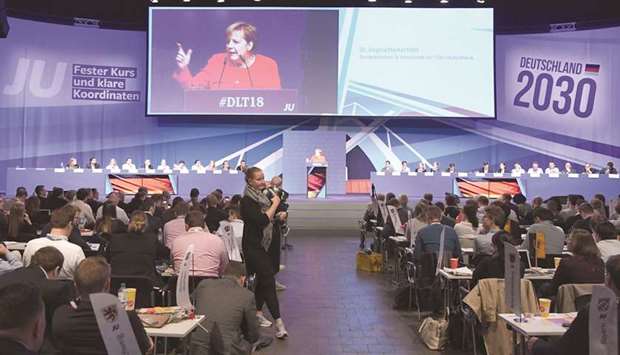
Merkel’s Christian Democrats (CDU) and their Bavarian Christian Social Union (CSU) sister party have struggled to maintain a united front on immigration policy and the fate of the scandal-hit domestic intelligence agency.
Polls indicate the CSU will lose its absolute majority in the Bavarian parliament in an election in the southern state on October 14, bleeding support to the ecologist Greens and the far-right Alternative for Germany (AfD) party.
Support for Merkel’s CDU is also projected to fall, to around 29 %, in an election in the state of Hesse two weeks later.
The party won 10 percentage points more in the election five years ago in Hesse, where it governs with the Greens.
“I know that through our dispute we have contributed to making the polls look as they do,” Merkel told the CDU/CSU youth wing in a speech in the northern city of Kiel. “Voters don’t appreciate it if we argue and they don’t even understand what we’re arguing about.”
“We’re a people’s party of the middle, which includes all three roots: conservative, Christian-social, liberal,” she said in a talk with the head of the conservative bloc’s Junge Union (JU) youth wing, Paul Ziemiak.
The meeting is considered a test for Merkel ahead of a CDU party convention in early December in Hamburg.
Merkel’s authority has been waning since an inconclusive election in September last year that produced the worst result for her conservatives since 1949.
Her first attempt to form a government with the Greens and Free Democrats (FDP) was unsuccessful, forcing her to turn to the centre-left SPD to secure a fourth term.
She had to make painful concessions to the SPD, including ceding the prized finance ministry, to get the party to reverse its decision to be in opposition and join the government as coalition partners.
She has since faced calls from her own party to name a successor.
Yesterday the CDU/CSU youth wing demanded a constitutional amendment to limit the number of terms that a chancellor can serve to three.
Merkel rejected this idea, saying that it would breach the constitutional rights of lawmakers to have the freedom to vote for any chancellor candidate they want.
Merkel’s coalition has been lurching from one crisis to another.
In the summer, CSU leader and Interior Minister Horst Seehofer brought the government to the brink of collapse with a threat to turn back migrants at the border with Austria if they had already applied for asylum elsewhere in the European Union.
Seehofer’s hardline on immigration has not helped his to CSU reverse a slide in support in Bavaria, the main gateway for migrants coming to Germany.
Voters in the wealthy state appear to be unimpressed with his anti-immigration rhetoric.
Those opposed to Merkel’s decision in 2015 to open Germany’s borders to some 1mn, mainly Muslim asylum-seekers, are turning to the AfD.
Yet others are leaving the CSU for the Greens, who are projected to become the second-biggest party in Bavaria on October 14.
Seehofer, the loudest critic of Merkel’s liberal immigration policies, yesterday ruled out giving up his post as CSU leader after the election, vowing to stay on until the end of his term next year.
Asked by the Welt am Sonntag newspaper if he would stay, he said: “Of course! I have a big project to complete.”
Alexander Dobrindt, a leading CSU official, told the JU gathering that “the unity of CDU and CSU is unshakeable, even if we differ on details at times”.
Merkel’s coalition was beset by another major dispute this summer over the career of sacked domestic intelligence chief Hans-Georg Maassen after comments he made on violence at right-wing protests.