


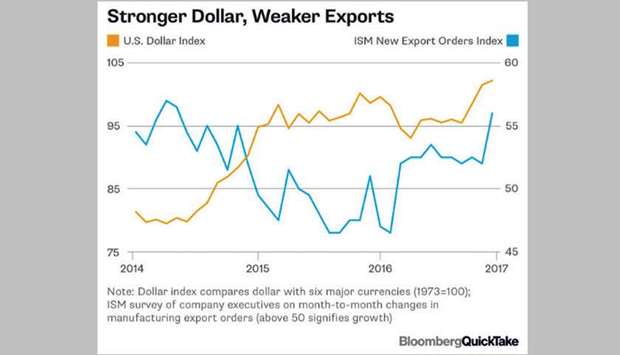
For decades, the US stood out as the one nation that traditionally preferred its money superpower-strong. Investors flocked to it, enabling the US to borrow lots of money at low interest rates. American consumers feasted on it, buying imported goodies for less. US politicians touted it as evidence of the economy’s eternal dynamism. But under President Donald Trump’s “America First” manifesto, the so-called strong-dollar policy is getting shoved aside. As other countries drive their currencies down, the strong dollar crimps US exports and hurts American multinational companies’ earnings. For the rest of the world, danger lurks in dollar-denominated debt sold in emerging markets like Brazil and India; a stronger dollar makes those bonds harder to repay. With so many negative consequences, the question now is whether the strong-dollar dogma is becoming a relic, or is just in hiatus?
The Situation
The dollar jumped 6% since mid-February by mid-July against the world’s major currencies and remains well above the average of the past decade. The rise is fuelled by US economic strength, Federal Reserve interest-rate increases and companies repatriating profits from abroad, thanks to recent tax changes. The increase came despite Steven Mnuchin, the US Treasury secretary, openly acknowledging in January 2018 that a weaker greenback was good for US trade. The president obliterated any remaining strong-dollar allegiance with a July 20 tweet saying the strengthening dollar was “taking away our big competitive edge.” A less muscular greenback aligns with Trump’s protectionist policies, including a desire for lower trade deficits and increased exports of American goods. At the same time, his growth-boosting tax cuts and higher federal spending are likely to reinforce the direction of Fed policy, which is to keep raising borrowing costs and thus continue support for the dollar.
The Background
The US economy became the world’s largest in the 1870s, yet the British pound remained the dominant currency. That changed starting with the creation of the Federal Reserve in 1913. World War I helped too by forcing other nations to suspend convertibility of their money to gold. The Bretton Woods agreement made the dollar’s pre-eminence official in 1945 as US money became the standard used to fix exchange rates. That system collapsed in 1971, but the dollar’s ascendancy continued. In 1985, the Plaza Accord reached by the US and the other four richest economies pushed down the dollar’s value for a while to slow Japanese exports. It didn’t last. The dollar remains the dominant reserve currency, used by countries to pay international debts. In 1995, Treasury Secretary Robert Rubin asserted that a strong dollar is in the US national interest, a mantra repeated by each of his successors (though not always with conviction). Even the global financial crisis of 2008 strengthened the dollar, as investors sought safety in US government debt.
The Argument
There are always winners and losers when a nation’s currency rises or falls. Yet Treasury secretaries since 1995 have pledged allegiance to the strong dollar, mostly to signify US strength, even if they sometimes mused openly about the benefits of a weaker currency on jobs and economic growth. While US officials often criticise other countries that manipulate their currencies, they aren’t blind to the benefits of a falling greenback. In 2016, the surging dollar weighed on the Fed’s plans to raise interest rates, with chair Janet Yellen saying it had harmed US exports. Former Treasury Secretary Lawrence Summers also warned in early 2017 that a stronger dollar would hurt American workers who are competing with Mexico. By abandoning the strong-dollar mantra, Trump may be signifying he’s willing to toss tradition aside and join ranks with other countries that have weakened their currencies to get a leg-up in world trade.
For decades, the US stood Americ