


Danske Bank faces a US criminal investigation into a €200bn ($230bn) money laundering scandal at its Estonian branch which has rocked investor faith in Denmark’s biggest lender and forced its chief executive to quit.
Shares in Danske Bank have lost a third of their value this year on fears of a US inquiry because of the potential for significant penalties such as fines or being frozen out of dollar funding.
Danske Bank said it had “received requests for information from the US Department of Justice (DoJ) in connection with a criminal investigation relating to the bank’s Estonian branch”. The bank, which this week appointed Jesper Nielsen as interim CEO to handle the crisis in the short term after Thomas Borgen resigned last month, said on Thursday it was cooperating with the US authorities.
Danish business minister Rasmus Jarlov has said Denmark wants to avoid a repeat of the case of ABLV in Latvia, where the bank was accused by US authorities of covering up money laundering.
ABLV was denied dollar funding and collapsed.
Shares in Danske Bank fell by 4.6% to 158.70 Danish crowns, their lowest level since January 2015 as its investors and customers digested the US inquiry and the bank’s decision to halt share buybacks to bolster its capital.
The mayor of Copenhagen, Frank Jensen, said the Danish capital was looking into ending its cooperation with Danske Bank as a result of the unfolding scandal.
Investors have fretted for months over the possibility of US authorities investigating whether Danske Bank broke US rules and at least one shareholder litigation company says it is looking closely to see whether it can bring a damages claim.
The DoJ, Denmark’s state prosecutor for financial crime (SOIK), the Financial Services Authority (FSA) and the central bank all declined to comment.
“We think a fine of $6bn, unlikely in our view given no sanctions/terror violations have been uncovered as yet after investigating high-risk customers, is already reflected in the price,” Jefferies analyst Kapilan Pillai said in a note.
France’s BNP Paribas reached a record $8.9bn settlement with US authorities in 2015 to resolve claims that it violated sanctions against Sudan, Cuba and Iran.
Many of the non-resident accounts at Denmark’s Estonian branch were held by entities or individuals in Russia, which is the subject of US sanctions.
Danske Bank’s troubles are having a ripple effect across the region and on Wednesday Estonia’s central banks said banks there handled more than $1 tn in cross-border flows between 2008 and 2017.
Sweden’s Swedbank and Nordea, the Nordic region’s biggest bank, both said they were not under investigation over money laundering. In a sign of the impact of criminal and regulatory investigations in Estonia, Denmark, Britain and now the United States, Danske Bank said it would end its plan to buy back shares worth 10bn Danish crowns ($1.5bn) by February.
It said it had bought shares worth 6.8bn Danish crowns by the end of last week.
This decision followed an assessment by Denmark’s financial regulator which said Danske Bank’s compliance and reputational risks had risen.
The FSA did not mention the US inquiry in a 12 page follow-up report published by Danske Bank.
The FSA said in May that Danske Bank’s Pillar II capital requirements should rise by 5bn Danish crowns but has now ordered it to double this to a minimum of 10bn crowns.
The bank raised its CET1 capital ratio target to around 16% from 14-15% and its total capital ratio to above 20% from an earlier target of above 19%. By end of the second quarter the bank’s CET1 ratio stood at 15.9% and its total capital ratio stood at 21.6%.
“It is a signal from our side that we would rather be on the safe side, rather than being seen on the other side, when it comes to capital,” Morten Mosegaard, Danske Bank’s interim chief financial officer and chief of staff told Reuters.
Last month a Danske Bank report said that payments totalling €200bn, many of which were “suspicious”, had moved through its Estonian branch between 2007 and 2015.
Borgen took “ultimate responsibility” for the findings of the report, which prompted renewed action by regulators, although he said he was cleared from a legal point of view.
The Danish bank’s board has asked Denmark’s FSA to approve the appointment next week of its head of wealth management Jacob Aarup-Andersen as its new chief executive, Danish online media Finans reported, citing several unnamed sources.
The FSA and Danske Bank declined to comment.
Politicians in Europe are calling for stricter measures after Dutch financial group ING was fined €775mn last month after admitting criminals had been able to launder cash through its accounts.
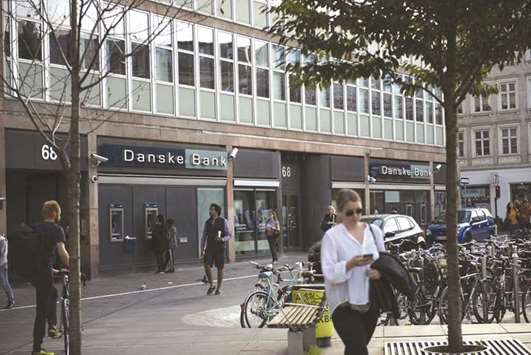
Customers use an ATM outside a Danske Bank branch in Copenhagen. Danske Bank said it had u201creceived requests for information from the US Department of Justice in connection with a criminal investigation relating to the bank’s Estonian branchu201d.