


The short-handed US Supreme Court yesterday launched its new term, with the legal arguments in its stately courtroom overshadowed by the harsh fight over President Donald Trump’s nomination of Brett Kavanaugh for a lifetime job as a justice.
There were eight justices, rather than the usual nine, following the retirement of long-serving conservative Justice Anthony Kennedy, effective in July.
Trump selected Kavanaugh to replace Kennedy, but the Senate confirmation process has been detoured as the FBI conducts an investigation of sexual misconduct allegations against the nominee.
The difficulties facing the court now that it is — at least temporarily — evenly divided ideologically with four liberals and four conservatives were on full display yesterday in the first of two cases argued before the justices. Kavanaugh’s confirmation would restore and deepen conservative control of the court.
A 4-4 split is possible in the case, a property rights dispute brought by timber company Weyerhaeuser Co seeking to limit the federal government’s power to designate private land as protected habitat for endangered species.
The dispute focused on the dusky gopher frog, an amphibian protected under the federal Endangered Species Act. Weyerhaeuser harvests timber on the Louisiana land in question and is backed in the case by business groups including the US Chamber of Commerce.
Weyerhaeuser challenged a lower court ruling upholding a 2012 US Fish and Wildlife Service decision to include private land where the frog does not currently live as critical habitat, potentially putting restrictions on future development opportunities.
The case pitted property rights against federal conservation measures.
The frog, found only in four locations in southern Mississippi, also previously inhabited Louisiana and Alabama.
While the liberal justices appeared sympathetic to the government’s defense of the critical habitat designation, the conservatives seemed to lean more toward the property owners.
“We know a habitat isn’t just where a species lives....It’s also where a species could live,” liberal Justice Elena Kagan said.
Conservative Justice Samuel Alito said that although some might not be concerned about a large company like Weyerhaeuser being forced to spend money on the property for the benefit of the frogs, the law would apply equally to a family farm.
A 4-4 ruling leaves lower court decisions in place and sets no nationwide legal precedent.
If Kavanaugh is confirmed, the court could decide to rehear the case with a full complement of justices.
The second case, to be argued after the frog dispute, involved the scope of a federal law that outlaws discrimination on the basis of age.
Chief Justice John Roberts began the day’s proceedings with business as usual by congratulating Justice Ruth Bader Ginsburg for her “distinguished service” during a quarter century on the court.
Before hearing their first arguments of the term, the justices issued a list of cases it was accepting and rejecting.
Among them, they rejected Bill Cosby’s bid to avoid a defamation lawsuit brought by a well-known former model, Janice Dickinson, who said the comedian sought to destroy her reputation after she publicly accused him of rape.
Trump nominated conservative federal appeals court judge Kavanaugh in July.
The FBI investigation, ordered by Trump on Friday under pressure from moderates in his own party, is due to last no more than a week.
For the current term, the court has some important cases, though none yet of the magnitude of the biggest from the previous term such as the fight over Trump’s ban on people from several Muslim-majority countries entering the United States.
One case involves whether a state and the federal government can each prosecute a person for the same crime.
Other cases include whether the US attorney general has too much power in determining to whom the federal sex offender registry applies, and whether a state can execute a convicted murderer who, after a series of strokes, forgot the crime.
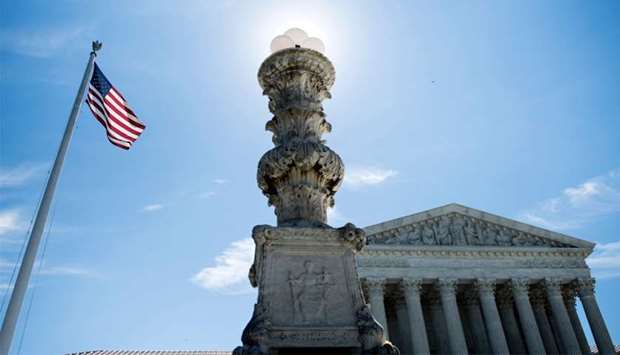
A view of the US Supreme Court