


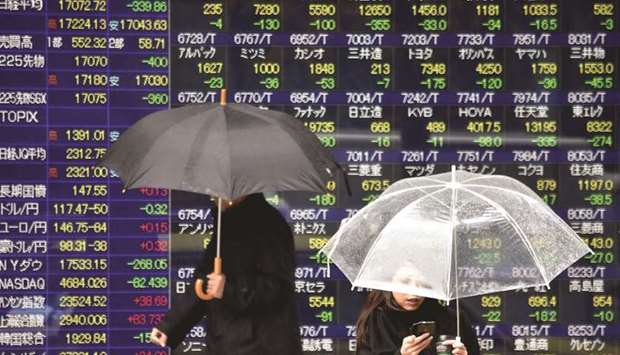
While emerging market contagion fears continue to stalk trading floors, Donald Trump’s protectionist drive returned to the fore following an indication Japan was next in the firing line, while Nafta talks with Canada amble along.
There was some relief that Trump did not immediately impose levies on $200bn of Chinese goods after the passing of a deadline for a public consultation.
The threatened tariffs would add to the $50bn in imports already targeted and mark a major step up in the long-running battle between the world’s top two economies.
Beijing has warned it will immediately retaliate against any measures, fuelling fears of an all-out trade war that is already showing signs of causing a drag on the global economy.
The president also appeared to be preparing to set his sights on Japan, with an opinion piece in the Wall Street Journal saying his good relationship with Tokyo “will end as soon as I tell them how much they have to pay”.
While Trump has mostly taken out his anger with China and Europe, he has often in the past complained of an uneven trade relationship with Japan.
Japan’s Nikkei led losses, ending 0.8% lower with exporters hurt by a stronger yen as dealers ran to the safe-haven unit for shelter from market turmoil.
“The timing of the WSJ story is significant as it serves as a reminder before an expected Japan-US summit later this month, when trade consultations will also likely be held,” said Daisuke Karakama, chief market economist at Mizuho Bank.
Sydney lost 0.3% and Singapore dropped 0.4%. Seoul gave up 0.3% and Manila was 1.1% off, while Taipei shed 0.7%. Hong Kong was flat after fluctuating through the day, while Shanghai gained 0.4% by the close and Jakarta added 0.7%.
Chip firms joined their Wall Street counterparts in turning south on growing concerns about demand after US semiconductor giant KLA-Tencor softened its outlook for the sector.
Samsung sank almost 3% in Seoul while SK Hynix was 3.7% lower. Tokyo Electron dived 6% and Advantest was more than 7% lower.
The “earnings trend in (the) semiconductor sector is bound to weaken further as end-demand remains lacklustre while orders have been at very elevated levels,” Amir Anvarzadeh, senior strategist with Asymmetric Advisors in Singapore, told Bloomberg News.
He called talk of a short, sharp fall over-optimistic.
In foreign exchanges, emerging markets currencies enjoyed some respite after recent losses, with the Indonesian rupiah and South African rand inching higher. Observers have warned of further turmoil as traders fear the crises in Argentina, Turkey and South Africa could spill over into other economies.
The upheaval has revived worries of a repeat from 1997, when a collapse in the Thai baht mushroomed into a much broader Asian economic crisis.
However, Credit Suisse investment strategist Suresh Tantia said the sell-off could provide long-term benefits for dealers. “Emerging-market equities are handcuffed by trade uncertainty and concerns around contagion risk at this point of time,” he said.
In Tokyo, the Nikkei 225 closed down 0.8% to 22,307.06 points; Hong Kong — Hang Seng ended flat at 26,973.47 points and Shanghai — Composite closed up 0.4% to 2,702.30 points yesterday.