


The shadow Brexit secretary, Keir Starmer, has said during a visit to Brussels that Labour would vote against a proposed EU-UK free trade deal that is now being backed by Michel Barnier and David Davis, leaving such an arrangement with scant hope of being passed by parliament.
He also described as “reckless” efforts to pretend that Theresa May’s Chequers proposals were not dead, as the value of the pound leapt in response to fresh reports that Angela Merkel was open to a more vague political declaration on the UK’s future economic and trade ties in order to get a Brexit deal done.
Barnier, the EU’s chief negotiator, and the former Cabinet ministers Davis and Boris Johnson have suggested in recent days that a Canada-style deal that avoids tariffs on imports but only minimises rather than avoids checks on imports is the way forward.
It has been suggested by some member states, in the face of opposition from France, that such an offer could be dressed up to allow both sides to claim a victory, in what has been described as a “blind Brexit”.
But, speaking between meetings with key EU diplomats and officials including Barnier’s German deputy, Sabine Weyand, Starmer told the Guardian that while he agreed with the European commission and Tory Eurosceptic MPs including Jacob Rees-Mogg that the Chequers proposals were dead, Labour would not accept a Canada-style deal, however it was presented.
Starmer said it was clear that May’s central proposals of customs facilitation and a common rulebook on goods but not for services “cannot form the basis of a deal” and that the prime minister and others should not pretend otherwise.
It was therefore vital, in order to win parliament’s support, he said, that May moved to back a deal that brought the UK further into the EU’s orbit, by negotiating a new customs union and signing up to EU acquis on both services and goods while accepting the jurisdiction of a common court.
Starmer pointed out that his party had set the government the task of meeting a series of targets in order to gain its support in parliament, including that the deal offers the “exact same benefits” as the UK currently has as a member of the single market and customs union and that it delivers for all regions of the country.
He said: “We have our six tests and (the free trade deal) wouldn’t meet them and I don’t think it would be approved by the Conservative party because you have the other wing who would be concerned about the distance between a Canada deal from where we are now.
“At the end, the central problem for the prime minister is always the same: she has a warring party behind her, and the two sides can’t agree sufficiently to allow her to get a deal through unless she goes for a customs union plus single market deal with shared regulations and institutions. That I think would have a majority in parliament.”
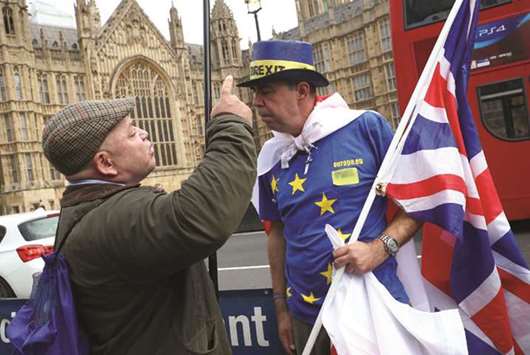
Pro and anti-Brexit protesters demonstrate outside the Houses of Parliament in London yesterday.