


The police report was matter-of-fact: A man had been walking his lioness on a leash down a forest path when another man on a mountain bike approached. “Contact occurred between the lioness and the passing cyclist, who afterwards had to be treated by a doctor,” the officials noted. It may read like something from Africa, but it actually occurred in the small Czech village of Zdechov. And the incident isn’t even that surprising: There’s been something of a wildcat boom in the Czech Republic in recent years.
Tomas Kocourek is the mayor of Zdechov, and although his surname translates as ‘small cat,’ he’s not a huge fan of big cats roaming around his village. “Furious mothers call me after being out for a walk with their children,” the politician says. And these encounters are far from rare.
Kocourek has few legal means to tackle the fact that people are keeping the predators as pets, since they’re not banned. “I can’t do anything, apart from appealing to the owners’ conscience,” says the mayor, who has been in office since November 2006.
Only a few of the village’s 600 inhabitants are in favour of the lions being kept in Zdechov, which lies on the border with Slovakia, due to the tourists they attract. There are more than 250 big cats living with private owners and breeders in the Czech Republic. The country’s municipal zoos object to the practice.
“I personally think it is wrong to keep lions or tigers for your private pleasure,” says Miroslav Bobek, Director of Prague Zoo, the largest in the country, with more than 1.5 million visitors a year. For years, Bobek has been demanding legislation to protect these rare animals - and the public. “Even a dog has to be kept on a leash in the city - but not a lion,” says the zoologist.
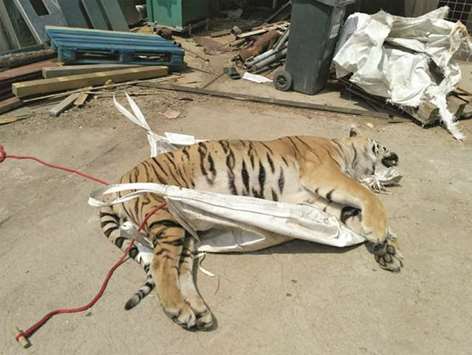
In the Czech Republic, there are a whole series of so-called ‘zoo parks’ or ‘nature parks,’ where big cats often live in poor conditions. These have nothing in common with real zoos like his, Bobek says. In July, two tigers and a lion escaped from their transport cages in just such a ‘nature park.’ There was a massive police operation to recapture them, during which the inhabitants of a nearby village were not allowed leave their homes. In the end, the animals were found resting under a shady tree and were safely tranquilised and captured. Another case, however, did not have such a happy ending. Three tigers were found dead in mid-July in a so-called zoo park near Prague. The police found one freshly killed tiger and two deep-frozen carcasses, as well as tiger skins and products.”
Investigators believe the tiger parts were intended for use in traditional Chinese medicine. Tiger products fetch high prices on the black market in Asia. For centuries, they have been believed to have healing properties. Three suspects of Czech and Vietnamese nationality were taken into custody following the discovery. There was enormous media interest in the case, due to the fact that one of the accused was a distant relative of a respected circus family. The circus publicly distanced itself from the man.
The Washington Convention on International Trade in Endangered Species of Wild Fauna and Flora (CITES) prohibits any commercial trade in tiger products, since the feline predators are considered highly endangered. Nevertheless, the recent revelations in the Czech Republic do not seem to be an isolated case. According to research conducted by the animal rights group Four Paws, between 1999 and 2016, more than 8,200 illegal tiger products such as tiger soup cubes, teeth and claws were confiscated in the European Union.
According to the organisation, just one kilo of tiger bones can earn an average of 1,700 euros on the black market. At the end of July, the Czech government finally announced initial measures to counter the trade, including a ban on exports of live tigers to third countries outside the European Union.
It is not clear what will happen to them once they are intercepted. The animal rights activists of Four Paws warn: ‘Legal trade fuels illegal trade.’– DPA
TOURISM: Only a few of the village’s 600 inhabitants are in favour of the lions being kept in Zdechov, which lies on the border with Slovakia, due to the tourists they attract.