


Toyota Motor Corp is aiming to triple car production in China by as soon as 2030 in a renewed push to make up lost ground in the world’s biggest market, according to people familiar with the plan.
Asia’s largest automaker is targeting to manufacture 3.5mn vehicles annually in China around that year while boosting imports to the country to half a million vehicles, the people said, asking not to be identified as the internal goal is private for now.
Toyota can currently produce 1.16mn cars in China annually, and sold 1.3mn there last year for a 4.5% market share.
Volkswagen AG and General Motors Co delivered more than 4mn each.
The foray comes as Chinese officials warm to the hybrid technology that Toyota pioneered with the Prius, amid a realisation that electric vehicles alone probably won’t be able to achieve Beijing’s ambitious environment targets, two of the people said.
The government is aiming for a fifth of car sales by 2025 to be so-called new-energy vehicles, which include pure EVs and plug-in hybrids.
Stringent quotas for NEV production go into force from next year.
Toyota is working to correct its course in a market where VW, GM and local manufacturers such as Geely Automobile Holdings Ltd are strengthening their presence with line-ups heavily featuring plug-in vehicles.
Geely, controlled by billionaire Li Shufu, overtook all its Japanese rivals to became China’s third-biggest automaker by sales this year.
By contrast, Toyota had to delay the introduction of a plug-in hybrid Corolla until next year, with an EV version of its compact crossover C-HR not due until 2020.
The China push is one way Toyota is adapting to fast changes in the car market – a focus on self-driving vehicles is another.
On Tuesday, Toyota said it is investing $500mn more in Uber Technologies Inc and that it plans to manufacture minivans loaded with the US company’s software, with testing slated to begin on Uber’s ride-sharing network in 2021. Some of the China-made vehicles may be bound for other markets in Asia.
Nanfang Daily, the Guangdong provincial government’s official newspaper, cited Toyota’s top China executive as saying the country would become a hub for the company’s NEV exports to the rest of Asia.
Toyota declined to confirm the comments.
The Toyota City-based company aims to boost Chinese capacity to 2mn vehicles annually by the early 2020s on its way to the 3.5mn-vehicle-a-year production target, two of the people said.
Shares of the automaker rose 0.6% in Tokyo yesterday. They have fallen 2% this year, compared with about a 6.5% decline for an index of Japanese car manufacturers including Toyota.
The company plans to expand capacity in Tianjin by 120,000 units annually with local partner China FAW Group Co, according to a document posted on a local government website. The investment will total 1.76bn yuan ($259mn), with 110,000 of the vehicles being plug-in hybrids and the remainder EVs, according to the document.
Additionally, Toyota will build a new factory in Guangzhou with its other local partner, Guangzhou Automobile Group Co, capable of producing 200,000 vehicles a year, Nikkei reported over the weekend.
The joint venture is also expanding its existing facilities to make an additional 120,000 cars, bringing annual capacity to 1.7mn units by 2021, the newspaper said.
Toyota said it is studying how to reinforce its organisation to accelerate its Chinese business, but declined to comment on specific moves.
Toyota said it positions China as one of the most important countries within the global market. The plans don’t come without challenges. After years of rapid growth, the Chinese market is showing signs of cooling.
Auto sales expanded just 3% in 2017, the slowest rate in recent years, with a similar pace forecast for the current year, according to the state-backed China Association of Automobile Manufacturers.
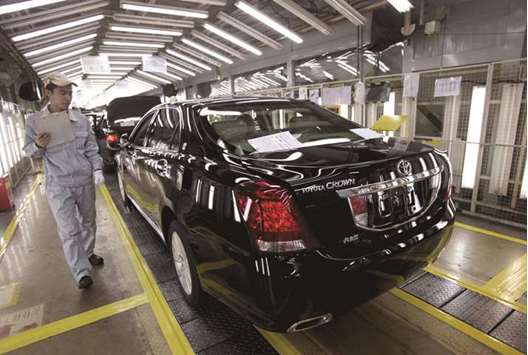
An employee checks newly produced cars at a Toyota factory in Tianjin, China. Asia’s largest automaker is targeting to manufacture 3.5mn vehicles annually in China by 2030.