


Poetry’s ability to transcend language, culture, and human differences is extra-ordinary. There is arguably no genre more visceral than this one, or more expressive. Ghalib’s romantic and philosophical poetry, the lyric and mystic work, is a doorway for those looking to feel, escape and be transported elsewhere for a moment or two. Ghalib’s poems, especially his ghazals, remain beloved throughout South Asia and worldwide for their arresting intelligence and lively wit. His work reveals the vigour of his prose style.
Bazm-e-Urdu Qatar (BUQ) has been actively trying to keep Urdu language alive and promote literature among expatriate communities in Qatar since its inception in 1959. It was founded as a platform for aspiring poets and already established ones from Pakistan and India, residing in Doha.
Keeping up with tradition of BUQ, its associated group called Guzargah-e-Khiyal (Road of Imagination) recently held Ghalib symposium. The programme, a regular feature of Guzargah-e-Khiyal, was 63rd session on the poetry of Mirza Asadullah Khan Ghalib, most popular Urdu poet.
Mohammed Rafique Shaad Akolvi, BUQ President and a noted Urdu poet, hosted the programme at his house at West Bay. Syed Abdul-Hye, BUQ senior patron, presided over the session. A good number of Urdu poets and lovers from both Indian and Pakistani communities attended the session and enjoyed the discussion on the work of Ghalib.
The organisers shared a selected ghazal of Ghalib with the participants and started discussion on every verse of the ghazal. Every participant gave his input and explained the verses according to their owning understanding. However, the elaborations made by Urdu literature experts were exceptional as they unfolded different layers of meanings conveyed by the great poet. The participants not only learnt how the poet used different phrases and expressions to convey his thoughts, they also enjoyed the sublime ideas penned by Ghalib.
Two prominent Doha-based Urdu poets presented tazmeen of the ghazal. Tazmeen is an Urdu literary term. The poets took one line from a verse of Ghalib and added their own second line to make a new verse. Muzaffar Nayyab presented serious tazmeen of the ghazal and earned appreciation from the gathering for his creativity. Iftikhar Raghib, Urdu poet, presented humorous tazmeen of the ghazal.
Talking to Community, Dr Faisal Hanif, BUQ Chairman and founder of Guzargah-e-Khiyal, said, “The sessions were started to discuss poetry of great Urdu poets. The forum tries to understand the Urdu poetry and to cultivate love and admiration for poetry among the audience. We have been organising these sessions to understand Ghalib’s poetry for five years. We pick one ghazal from Dewan-e-Ghalib. So far, we have discussed 104 ghazals of Ghalib.”
He added, “Ghalib is considered as one of the most difficult Urdu poets to understand. We try to understand his diction, language, thoughts, and imagination. We believe that if the Urdu lovers can understand Ghalib, it will not be difficult for them to understand other poets or writers as well. The session is not a mushaira but an intellectual discussion on works of Ghalib. We try to understand multi-layers of thoughts shared by Ghalib. There has been a lot of research carried out on Ghalib’s work. The work goes on and people continue to explore Ghalib.”
Mohammed Rafique Shaad Akolvi said, “I have been associated with BUQ since 1987. I have long been hosting the sessions on Ghalib. I think the session provides an opportunity to learn Urdu language and literature. If you can understand Ghalib, you will be able to appreciate all kinds of Urdu literature.”
He added, “The session on Ghalib is a very unique activity currently going on in Qatar for Urdu lovers. The sessions teach how to appreciate the Urdu poetry. It has been beneficial both for writers and common Urdu speakers. We always invite different Urdu poets both from India and Pakistan to our sessions and ask them to share their thoughts on the works of Ghalib. After finishing the work of Ghalib, we will start our sessions about the Urdu creative works of Dr Muhammad Iqbal.”
Iftikhar Raghib said, “Today, we learnt how Ghalib conveyed his opinion and thoughts on his times through the selected work. As a poet, I have improved myself by attending these sessions. It is a unique programme. We thoroughly and slowly study Ghalib.”
He noted, “Mostly, men of letters attend these sessions and they learn about Ghalib and then convey it to common readers through their works. These sessions are a good source of promoting Urdu language and literature.”
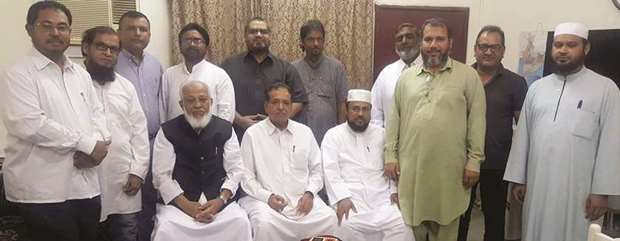
GROUP: Members of Bazm-e-Urdu Qatar in a group photo after the session. Photos supplied