


Researchers expressed concern yesterday about the pace of climate change, after it was reported on Wednesday that a glacier on Sweden’s Kebnekaise mountain had melted so much in sweltering Arctic temperatures that it is no longer the country’s highest point.
“It’s quite scary,” Gunhild Ninis Rosqvist, a Stockholm University geography professor who has been measuring the glacier for many years as part of climate change research, told AFP.
“This glacier is a symbol for all the glaciers in the world. This whole environment is melting, the snow is melting, and it affects the entire ecosystem: the plants, the animals, the climate, everything,” said Rosqvist, who is also the head of the Tarfala research station near Kebnekaise.
“You see the effects of climate change so clearly here. And for Sweden, Kebnekaise’s southern peak is such an iconic symbol,” she added.
A popular tourist destination located in Sweden’s far north, Kebnekaise has two main peaks – a southern one covered by a glacier and a neighbouring, northern one free of ice.
The southern peak lost 4m (13’) of snow between July 2 and July 31.
“It looked different this year. The snow was melting, the glacier surface has never been as low as it is now. I saw meltwater trickling down the sides, I’ve never seen that before,” Rosqvist said.
When measured early on Tuesday, the southern peak reached 2,097m above sea level, just 20cm higher than the northern tip’s 2096.8m.
On a daily basis in July, the southern peak lost an average 14cm of snow, as Sweden registered record temperatures that triggered dozens of wildfires.
Rosqvist said yesterday that the southern peak was most certainly lower than the northern peak.
“We haven’t gone up today to measure it, but we’ve checked the temperature and it was really warm yesterday, it was over 20°C (68°F) so it has surely melted” below the level of the northern peak, she said.
Rosqvist and her team will measure the peak again around September 8, “when the summer is over”.
“It could easily be 1m under the northern peak by the end of summer,” she said.
The southern glacier, whose height has been registered since 1880, has been melting by 1m every year over the past two decades, according to Stockholm University.
The glacier could grow this coming winter and the southern peak could even rise above the northern peak again, before some of it melts away next summer if the weather is warm.
According to Martin Hedberg, meteorologist at the Swedish Weather and Climate Centre, “extreme heat is 100 times more common today than it was during the 1950s, 60s and 70s” globally.
“The temperature differences between the Arctic and the Mediterranean are narrowing,” he told AFP.
Kebnekaise’s two peaks may compete for the title of Sweden’s highest point for the next few years, Rosqvist predicted.
She lamented that political targets to combat climate change, including the Paris Agreement which calls for capping the global rise in temperature at 2°C, were not having enough of an impact.
“With these targets, our glaciers are going to disappear. It’s an election this year in Sweden, and yet no one is talking about this,” she bristled, referring to the country’s general election on September 9.
With the last three years being the hottest ever recorded on Earth, she said that changes are needed “in the way our societies are structured” to reduce greenhouse gas emissions.
She cited cuts in fossil fuel usage and more electric cars as examples.
“Many people want these changes, and they’re prepared to change their consumer habits,” she added.
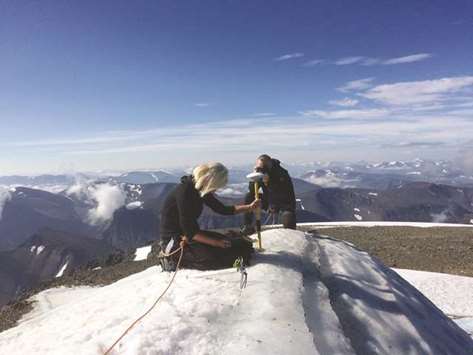
A handout picture released by Stockholm University on Wednesday and taken on July 31 shows Rosqvist taking measurements atop Sweden’s highest peak, a glacier on the southern tip of the Kebnekaise mountain in northern Sweden.