


World equities markets were in the red yesterday as trade war fears ratcheted higher after the United States said it was looking at more than doubling threatened tariffs on a range of Chinese imports.
In London, sterling slipped after the Bank of England hiked its key interest rate by a quarter-point to 0.75%, but seemed reticent to announce any further rate rises amid Brexit uncertainty.
Key European markets closed the session with hefty losses, while on Wall Street the Dow was also lower approaching midday.
In American earnings news, Tesla motors surged 8.5% after it reported a bigger-than-expected quarterly loss of $717.5mn, but said it was on track to become profitable the rest of the year.
Earlier, Asian stocks sank after the US administration confirmed it was considering hiking levies to 25% from the announced 10% on $200bn of Chinese goods.
Should the US follow through, it would be “a considerable step-up in the trade dispute between US and China and would start to seriously threaten global growth,” wrote Konstantinos Anthis, head of research at ADSS.
China’s Foreign Minister Wang Yi yesterday called on the US to remain “cool-headed”, but that appeal alone appeared to do little to shift the mood on trading floors.
In Germany, the DAX blue chip index was down 1.5% at 12,546.33 points at the closing bell, with analysts blaming US tariff threats that would hit car manufacturers especially hard.
London’s FTSE 100 closed 1.0% down at 7,575.93 points and Paris’ CAC 40 ended 0.7% down at 5,460.98 points.
Meanwhile, the EURO STOXX 50 finished 1.1% at 3,469.21 points.
Investors and analysts welcomed the BoE’s interest rate announcement, with head of research at London Capital Group Jasper Lawler tweeting: “Bravo to BoE for finally putting rates on course to something normal.”
However he added: “Shame it has left it so late that chances of a quick reversal are much higher.”
Rising interest rates are a boon for savers but ramp up the cost of credit for consumers and companies.
On currency markets, the pound at first edged slightly higher in response to the rate hike, only to then drop below the level seen just before the meeting.
“The pound’s sharp decline could be based on investors acknowledging that today’s rate hike is a ‘one-and-done’ move,” wrote Lukman Otunuga, research analyst at FXTM.
“With Brexit uncertainty, cooling inflationary pressures and global trade tensions likely to obstruct the central bank’s efforts to raise interest rates, the pound remains vulnerable to downside risks,” he added.
The BoE’s decision came a day after the US Federal Reserve held fire on interest rates, even as it highlighted the strength of the US economy and labour markets, indicating rate hikes ahead.
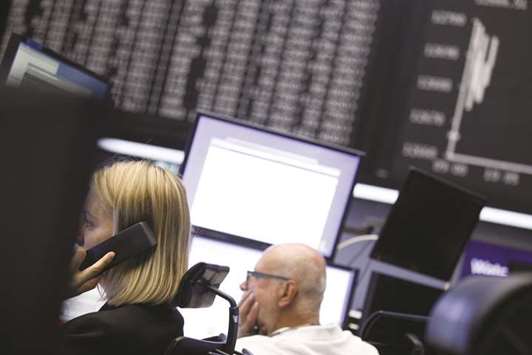
Traders monitor financial data inside the Frankfurt Stock Exchange. The DAX blue chip index closed 1.5% down at 12,546.33 points yesterday.