


French lawmakers refused yesterday to back two opposition motions to bring down the government over an alleged assault on a protester by an aide to President Emmanuel Macron.
Prime Minister Edouard Philippe told the National Assembly that Alexandre Benalla’s action during riot-marred May Day protests were “individual faults” that “say nothing about the presidency of the Republic”.
Philippe argued that Benalla had been promptly sanctioned for the incident, in which he was caught on video, wearing a police helmet and in the company of riot police, grabbing a young man, throwing him to the ground and apparently stamping on him.
However, Christian Jacob of the conservative Les Republicains opposition said that the French people “have been dumbstruck by this affair”.
The opposition has accused Macron of a cover-up, because Benalla was at first just suspended for 15 days and reassigned and the incident was not reported to prosecutors.
According to police and Elysee officials, Benalla had joined police on the day as an observer, but was not supposed to take an active part in police actions.
“These acts, if they had not been revealed by the press, would have remained a secret closely guarded by a few politicians and officials who felt they did not have to report them, no doubt for fear of the prince’s reaction,” Jacob argued, in a jab at Macron for being monarchical.
“Since the acts under scrutiny appear to have been covered up by free passes at the highest levels of the state, there is indeed a ‘Benalla affair’,” Socialist MP Valerie Rabault told Philippe and other cabinet ministers ahead of the votes.
“The disease runs deep – it’s called presidentialism,” said leftist leader Jean-Luc Melenchon, accusing Macron of holding himself above parliament and the judiciary.
Prosecutors opened an investigation into the incident earlier this month after newspaper Le Monde identified Benalla in a video of the scene posted on social media.
The Elysee then sacked Benalla, citing new evidence that he had also wrongfully received access to confidential police surveillance footage of the incident.
The opposition has seized the opportunity to accuse Macron of failing to live up to his promise of a new and more ethical form of politics.
“The man who made the moralisation of public life one of the main promises of his campaign is now mired in what must be termed a scandal of state,” communist parliamentarian Andre Chassaigne charged.
However, Philippe argued that “democracy has worked”, noting that parliamentary and judicial inquiries were already under way.
And he listed what he said were the government’s achievements in implementing Macron’s reform programme, pointing to changes to the labour code, France’s exit from the EU’s excessive deficit programme, and smaller class sizes in troubled suburbs.
“We will not slow down, we will not give up on anything, we will go all the way with our project!” he vowed.
The result of the vote was a foregone conclusion as Macron’s centrist La Republique en Marche (LREM, the Republic on the Move) and its allies hold 358 of the National Assembly’s 577 seats.
The Les Republicains motion got only 143 out of the 289 votes needed to bring down the government, while a motion of censure from the assembly’s three left-wing groups got 74 votes.
Not a single of the president’s MPs broke ranks yesterday.
Earlier, the leader of Macron’s centrist party revealed that he had sacked the security official who was filmed alongside Benalla as the latter appeared to assault May Day protesters.
Party leader Christophe Castaner told a Senate investigation into the affair yesterday that Vincent Crase had been sacked after prosecutors opened an investigation into the incident in July.
Like Benalla, he had initially received a 15-day suspension.
However, Castaner said that as Crase had initially told him he was acting as a reserve gendarme during the protests, he had not considered it was up to him to report the incident to judicial authorities.
Despite the parliamentary victories, what has become known as the “Benalla affair” has left an impact on Macron’s presidency, denting his popularity and throwing parts of his agenda off-schedule.
As well as forcing his government to postpone a constitutional reform, the affair has pushed Macron down in the polls, with his popularity now at barely 36%, according to one recent survey.
It has also emboldened a fragmented opposition, which had been floundering since Macron’s landslide victory last year.
The scandal has also raised questions about Macron’s highly centralised governing style and the wide powers conferred on the president under France’s Fifth Republic.
“This scandal reveals above all the abuses of a hyper-presidential regime,” veteran Communist lawmaker Andre Chassaigne told MPs before the no-confidence vote. “This is not just a summer affair, it shows the ultra-concentration of powers by an elected monarch which undermines the very principle of separation of powers.”
Macron, a former investment banker, has dismissed the case as a “storm in a teacup”.
Although Macron will soon head off to the south of France for a summer break where he will host British Prime Minister Theresa May on Friday, the scandal will continue to make waves when lawmakers return in September.
The senate, France’s upper house of parliament, has set up an enquiry which may question the 26-year-old bodyguard after Benalla said in an interview that he is open to it, despite the separate judicial investigation opened by prosecutors.
LREM lawmakers have dismissed the votes as an attempt to derail Macron’s reform drive, with the debate over planned constitutional amendments already set back by the row.
“Trying to bring down a government and its reforms because one official went out of control?” tweeted LREM spokesman Gabriel Attal.
Confidence votes are fairly common in France: there have been more than 100 since the current constitution was adopted in 1958.
Only once has such a move actually brought down a French government, that of Georges Pompidou in 1962.
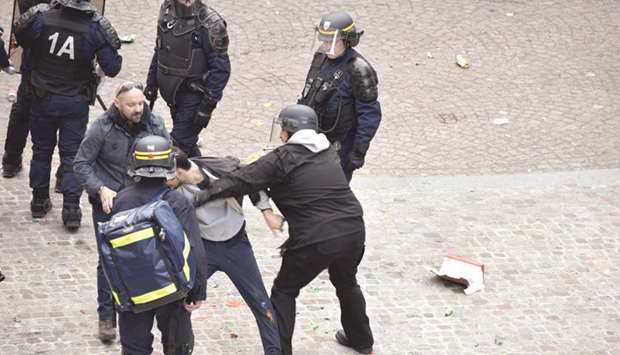
This file photo taken on May 1 shows Benalla (centre), wearing a police visor, next to Vincent Crase (centre left) as they drag away a demonstrator during a protest in Paris.