


In mist-covered hills, North Korean soldiers, sailors and civilians gathered yesterday at a heroes’ cemetery to commemorate their brothers in arms on the anniversary of the end of the Korean War.
Hostilities between the US-led United Nations forces and the North Koreans and their Chinese allies ceased 65 years ago with an armistice rather than a peace treaty, leaving the peninsula technically still in a state of conflict.
The two sides had fought each other to a standstill, millions were dead and Korea was a divided, war-ravaged ruin but the North’s self-proclaimed victory has long constituted a key plank of the Kim dynasty’s right to rule.
Platoon by platoon, units gathered at the graveyard on the outskirts of Pyongyang dominated by a towering sculpture of a rifle muzzle and bayonet, and adorned with the medal of a Hero of the Democratic People’s Republic of Korea, the North’s official name.
They laid flowers before an oversized granite coffin, draped in a metal flag and topped with a submachine gun and cap.
An announcer intoned: “Let us bow before the martyrs who took part in the Great Fatherland Liberation War” — Pyongyang’s name for the conflict — before the troops doffed caps and bowed.
According to official North Korean accounts, the first of the cemetery’s occupants to die, Jang Thae-hwa, 22, blocked a pillbox opening with his chest one day after the North invaded the South in 1950 so that his unit could advance.
Pyongyang’s histories say the last soldier killed in the conflict to be laid to rest at the site was Ri Hyon-jun, 20, a ground gunner who was made a Hero of the DPRK for shooting down four enemy aircraft, and died in a later engagement just five days before the fighting ended.
Ceremonies complete, the soldiers strolled between the rows of graves, arranged chronologically in order of time of death.
Unlike previous commemorations, propaganda posters focus on the heroism of the North’s troops, rather than condemning — or even naming — the enemy.
At a national conference of war veterans yesterday, politburo presidium member Choe Ryong-hae focussed on the “shining victory of the Juche-oriented military idea, strategy and tactics and outstanding commanding art of Kim Il-sung”.
This was in marked contrast to last year’s anniversary, when state media repeatedly referred to “the US imperialist aggressors” and newspapers proclaimed that the North would inevitably triumph over its longstanding enemy.
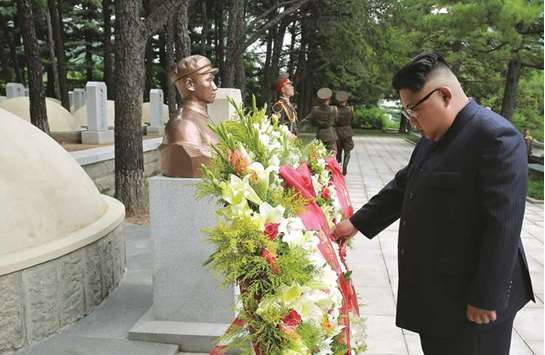
This undated picture released by North Korea’s official Korean Central News Agency (KCNA) yesterday shows North Korean leader Kim Jong-un laying a wreath during his visit to the Martyrs’ Cemetery of the Chinese People’s Volunteers in Hoechang, South Phyongan Province, to commemorate the 65th anniversary of the Korean War armistice.