


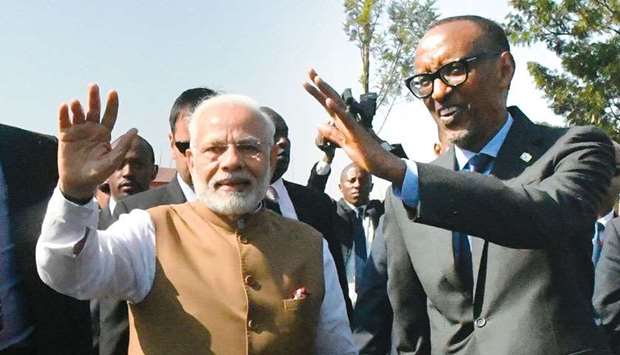
But Prime Minister Narendra Modi has staked a claim to the concept of “cattle diplomacy”.
During a visit to Rwanda yesterday, Modi donated 200 cows to poor residents of Rweru model village, south of the capital Kigali.
The gesture builds on a Rwandan government scheme called “Girinka” which since 2006 has contributed cattle to poor rural families in an effort to combat malnutrition by ensuring children have access to milk.
“Girinka” is a greeting in the local Kinyarwanda language meaning “may you have many cows”.
“I got a glimpse of rural life in Rwanda during the memorable visit to Rweru model village. I thank President Paul Kagame for accompanying me,” he said.
The Girinka scheme, which Modi said “is helping transform the lives of people across rural Rwanda”, has been celebrated for helping to reduce poverty by almost a quarter between 2000 and 2010.
Modi and Kagame also announced a series of deals including a a $200mn Indian loan that will be used to develop Rwanda’s irrigation schemes and expand the Kigali Special Economic Zone.
“During the talks, both leaders reviewed the entire gamut of bilateral co-operation and expressed satisfaction at the excellent relations between Rwanda and India in the overall context of Strategic Partnership,” the External Affairs Ministry said in a statement following delegation-level talks chaired by Modi and Kagame.
Ties between India and Rwanda were elevated to that of a Strategic Partnership in January last year.
According to the statement, Modi highlighted the fact that Rwanda would house the first of the 18 new resident Indian missions to be opened in Africa in 2018 and this underlined the importance attached by India to its relations with Rwanda.
Stating that India and Rwanda were looking forward to further elevate their ties, Modi, while addressing the media with Kagame following Monday’s talks, said: “This (opening the new mission) will not only facilitate close communication among our governments, it will also help in consular, passport, visa and other facilities.”
Agreements in the area of trade, defence, dairy co-operation, agriculture, culture, leather and allied sectors were also signed.
“The prime minister appreciated the effective utilisation of $400mn lines of credit extended to Rwanda in the last few years,” the ministry’s statement said.
In his address, Modi appreciated the steps for peace that have been adopted in Rwanda following the mass genocide in the country in 1994.
Up to 1mn people were killed in the mass genocide against the Tutsi people by the majority Hutu government of that time.
“For us, it is a matter pride that India is a trusted development partner of Rwanda,” Modi said.
“We have been helping Rwanda in capacity building, infrastructure development and ICT,” he said.
According to the ministry statement, Modi complemented Kagame for the important role he played as African Union Chair in finalising the African Continental Free Trade Area Agreement that has been signed by 44 countries.
“He expressed hope that his leadership will guide the African Union in furthering economic integration of the continent,” it stated.
“He indicated India’s willingness to continue to strengthen relations with African Union.”
Following the talks, Modi also interacted with the Indian community in Rwanda and invited them to visit India for the Pravasi Bhartiya Divas to be held in January next year.
Members of the Indian community of neighbouring states had also travelled for the interaction with the prime minister.
Modi also addressed the India-Rwanda Business and called for boosting economic ties between the two countries.
“Our nations can do a lot together,” he said. “There are several opportunities in rural development and small scale industries.”
He said that though India is growing exponentially, “our mantra is ‘sabka saath sabka vikas’”.
“We will grow but we will also help those who are with us grow,” the prime minister said. “We will walk together.”