


When it comes to NBA contracts, templates tend to become marginalised once the rookie scale is completed.
And yet, with Justise Winslow eligible for his rookie-scale extension this summer from the Miami Heat we now at least have some basis for comparison.
First came Josh Richardson’s four-year, $42 million Heat extension last September.
Granted, that was built off Richardson’s second-round status in 2015 and was the largest amount the Heat could offer. But an argument certainly could be made at the moment of Richardson’s standing as more polished than Winslow.
Then came Marcus Smart’s four-year, $52 million contract Thursday from the Boston Celtics. Granted, the deal came a season later in Smart’s career than where Winslow now stands, but there are similarities, in that shooting and scoring are not necessarily strong suits of either. For the Heat, the strategy could be the same as the Celtics utilized with Smart last summer – deferring.
As was the case with Smart during the 2017 offseason, the Celtics went through the process knowing that, at worst, Smart would be a restricted free agent this summer.
This summer, the Heat are in a similar position, with a $4.7 million qualifying offer in place for Winslow for 2019-20, allowing them to match any outside offer for Winslow next summer if an extension is not struck prior to the deadline of the 2018-19 season opener.
While deferring might make sense with a player who missed all but 18 games of 2016-17 due to injury and only late this past season got fully back up to speed, it does not avoid the ultimate peril of moving forward with Winslow at a significant price – the salary-cap impact during the 2020 offseason.
At the moment, the only Heat players under fully guaranteed contract for 2020-21 are Dion Waiters and Richardson. Everyone else on the roster either is off the books or has an option clause. Sign Winslow to an extension this summer or even a new contract next summer, and figure on at least another $10 million of 2020-21 cap space taken.
The reality is someone will spend on Winslow, especially now that the Celtics have established that making “winning plays” (sorry Erik Spoelstra, your term) can prove as fiscally rewarding as consistently making shots.
Like Winslow, Smart not only isn’t a starter at the moment, but well could remain a reserve for the balance of his four-year deal, based on the presence of Al Horford, Gordon Hayward, Jayson Tatum, Jaylen Brown and Kyrie Irving. With Winslow and his utility-knife skillset, the impression is that he can step up at many positions but not necessarily emerge as a clear frontrunner at any.
Wait too long and there always is a chance of getting burned, as the Chicago Bulls were this summer in having to match Zach LaVine’s absurd (albeit injury-protected) four-year, $78 million offer sheet from the Sacramento Kings or even the four-year, $84 million incentive-laden deal Aaron Gordon took to return to the Orlando Magic.
Of course, there also is the escape hatch of trading Winslow and therefore not only punting on the extension decision, but also creating the possibility of something friendlier to the 2020 offseason salary cap.
To a degree, the Heat’s current limbo is due, in part, to loading up the salary cap with supporting-level talent in James Johnson, Kelly Olynyk, Waiters and Tyler Johnson. (Hassan Whiteside was different; that was a case of going all in for a perceived top-tier talent).
So the question the Heat can address this summer and will have to address by the start of next summer is this: Can Justise Winslow be projected as a future star and will the Heat be a championship contender during the years of his contract? The Celtics, with Smart, decided the answer to the latter element of that question was yes.
If the Heat can’t answer in the affirmative with either element of that question, then it may become a case of moving on if Richardson-type money is deemed insufficient.
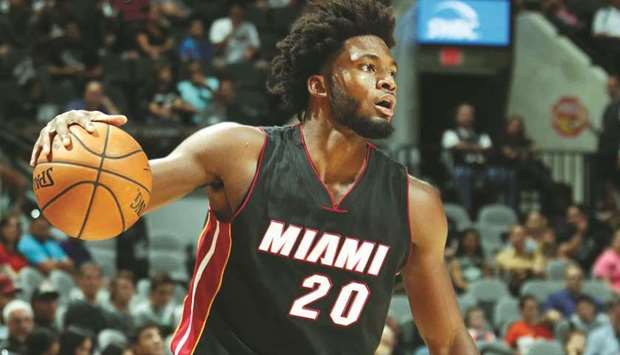
Justise Winslow