


In a 48-minute, expletive-free speech, Duterte said his two-year-old war against illegal drugs was “far from over.”
“Let me begin by putting it bluntly: the war against illegal drugs is far from over. Where before, the war resulted in the seizure of illegal drugs worth millions of pesos, today, they run (into)billions in peso value. I can only shudder at the harm that those drugs could have caused had they reached the streets of every province, city, municipality, barangay (village or suburb) and community throughout the country,” Duterte said.
“This is why the illegal drugs war will not be sidelined. Instead, it will be as relentless and chilling, if you will, as on the day it began,” he said.
The president then slammed human rights activists who have criticised the thousands of deaths caused by the anti-drug war, calling their efforts “misdirected.”
“If you think that I can be dissuaded from continuing this fight because of (your) demonstrations, your protests, which I find, by the way, misdirected, then you got it all wrong. Your concern is human rights, mine is human lives,” he said.
The bloody campaign against drugs killed 4,354 people from July 1, 2016 to June 30, 2018, based on the government’s RealNumbersPH. These fatalities reportedly resisted arrest during the 102,630 legitimate police operations conducted during the period.
The anti-drug raids have also resulted in the arrest of 147,802 drug personalities, including 229 elected officials, 52 uniformed personnel and 245 government employees.
Known for his long, impromptu speeches, Duterte stuck to his prepared text except for a few adlibs. Duterte’s first SONA in 2016 lasted for one hour and 32 minutes while his second SONA lasted two hours.
Duterte drew 34 applauses from the audience in his third SONA.
Duterte ordered government agencies to faithfully implement the law against red tape, saying some offices had a “lousy and corrupt bureaucracy.”
He told government offices “with a number of red tape-related reports from the public” to make their services “truly customer-friendly.”
Duterte signed the Republic Act 11032 or the Ease of Doing Business and Efficient Government Service Delivery Act of 2018 in May this year.
To achieve peace and development in Mindanao, Duterte said he would sign the Bangsamoro Organic Law in 48 hours. “When the approved version is transmitted and received by my office… The law has been passed actually and I intend to… Give me 48 hours to sign it and ratify the law,” he said.
Duterte was supposed to sign the proposed measure yesterday but this did not happen as the House adjourned its session before it could be ratified. The Senate was able to ratify the reconciled version of the bill.
Duterte, the first Philippine president from Mindanao, earlier certified the bill as urgent, prompting Congress to fast-track the passage of the draft measure. The bicameral conference committee approved the final version of the bill on July 18.
The historic law abolishes the Autonomous Region in Muslim Mindanao (ARMM) established in 1989 to administer Basilan, Lanao del Sur, Maguindanao, Sulu and Tawi-Tawi provinces. The ARMM will then be replaced by the Bangsamoro Autonomous Region.
Duterte also expressed confidence that Filipinos would rally behind his administration’s push for charter change.
Shifting to federalism from a unitary system is among the key campaign pledges of Duterte, who promised during the 2016 campaign to spread resources and political power to the countryside.
He thanked members of his consultative committee on charter change particularly former chief justice Reynato Puno and former senate president Aquilino “Nene” Pimentel Jr. for working on the draft federal charter.
The president also reiterated that he did not want to stay in power beyond the end of his term in 2022 under the 1987 Constitution or any other charter.
“I have no illusions of occupying this office one day longer than what the Constitution under which I was elected, or under whatever constitution there might be, (requires).”
In his speech, Duterte also boasted about his administration’s “improved” relationship with China, but assured the public that such renewed affinity between the two countries did not mean the Philippines wavering on territorial claims in the West Philippine Sea (South China Sea).
“Our improved relationship with China, however, does not mean that we will waver in our commitment to defend our interests in the West Philippine Sea. This is why we engage China through bilateral and multilateral platforms such as the Asean-China and the Philippines-China Bilateral Consultation Mechanism,” he said.
Duterte also admitted his hands were tied on the issue of ending contractualisation in the country.
“Read my lips, I understand that this does not satisfy all sectors. I share their sentiment; I truly do. Much as I would like to do the impossible, that power is not vested upon me by the Constitution. And neither will I make both ends meet even if I violate the laws to achieve that purpose. Simply, it is not part of my territory,” he said.
But the president renewed his call for Congress to pass legislation of ending the practice of contractualisation “once and for all.”
Duterte signed on May 1, the Executive Order 51 prohibiting the illegal contracting and sub-contracting of workers. He said the campaign against “endo” had resulted in the regularisation of 300,000 workers.
However, labour groups such as the Kilusang Mayo Uno want more, saying the president should have signed an EO that bans all forms of contractualisation.
The president also called on the senate to “urgently pass the National Land Use Act,” which he said would address competing land requirements for food, housing, business and environmental conservation.
“What has happened to Boracay is just an indication of the long-overdue need to rationalise, in a holistic and sustainable manner, the utilisation, management, and development of our lands,” Duterte said, referring to the popular tourist destination that he shut down earlier this year for a cleanup.
He reiterated his warning to miners against destroying the environment, insisting that extractive industries “must be used for the benefit of the Filipino people, not just a select few.”
“To the mining industry, I say this once again and maybe for the last time, do not destroy the environment or compromise our resources; repair what you have mismanaged. Try to change (your) management radically because this time you will have restrictive policies. The prohibition of open pit mining is one. It is destroying my country. It is destroying the environment. It will destroy the world of tomorrow for our children,” he said.
Duterte said tax reform would push through, adding such initiative was “incorrectly” blamed for rising consumer prices.
The Tax Reform for Acceleration and Inclusion or Train, which took effect on January 1 and raised duties on sugar-sweetened drinks, fuel and cars, has generated much-needed revenue to fund government infrastructure projects, according to Duterte.
Mixed reaction to president’s speech
Minority senators described the third SONA as a defeatist speech filled with promises already made during the 2016 election campaign. “The promise to continue relentlessly on the war on drugs is, as has been admitted, chilling and also senseless. Because daily killings have not solved and will not solve the drug problem,” said senator Francis “Kiko” Pangilinan, president of the Liberal Party.
Senator Ana Theresia “Risa” Hontiveros described it as a rerun. “Empty rhetoric. Hollow pronouncements. No real achievements. No vision,” she said. Another opposition senator, Antonio Trillanes said Duterte’s address was an admission of non-achievement.
“Worse, it was an admission that Duterte doesn’t have a clue on how to solve the serious problems being faced by our country most of which he created in the first place,” he added.
Representatives Edcel Lagman of Albay and Tomasito Villarin of Akbayan party-list made the same observations, but were surprised that there were no attacks on the opposition.
“The people want economic reforms to arrest poverty. Yet the president insists on the full implementation of the Train Law which has triggered the rise of inflation to 6.1% on food and non-alcoholic beverages, thus exacerbating food poverty, further reducing the people’s purchasing power, and decreasing the value of real wages,” Lagman said.
Other lawmakers were positive.
Muntinlupa representative Rozzano Rufino Biazon posted on Twitter that Duterte’s third SONA was clear on its objectives. “A SONA that I wanted to hear…one with a legislative agenda, a statement on the president’s stand on issues & a delivery that was fitting not just for his domestic audience but the international community. Regardless of one’s political leanings, it was a SONA one could listen to,” he tweeted.
Representative Sherwin Tugna of the party-list Citizens’ Battle Against Corruption said in a text message: “We applaud the president’s SONA. He stayed with his prepared speech. What our party list found the most for the benefit of the people is his mention of the National Land Use act.”
Oriental Mindoro Rep. Reynaldo Umali agreed. “I am happy with the president’s SONA message because it was clear and he defined his programmes, what he wants to continue. I think his message is clear that he will continue his advocacy on criminality, on drugs, and on corruption, and federalism,” he said.
Senator Aquilino Pimentel said President Duterte was able to enumerate his priorities in his third SONA. “He mentioned the things that I wanted to hear like endo, rice tariffs, federalism, and the fight against inflation,” he said.
Senator Joseph Victor Ejercito, however, expressed hope the president and his economic managers would reconsider their stance on the Train law.
“I maintain my view that we need to consider the suspension of the excise taxes on fuels - not the entire law - in order to protect Filipino consumers from spiraling prices of goods,” he said.
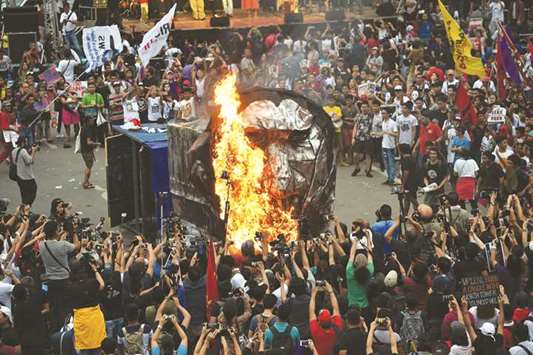
Rallies at Commonwealth Militant groups mustered a crowd of 15,000 against Duterte, while about 9,000 individuals gathered on IBP Road to show their support for the president.
“Initial reports from our ground operatives is 15,000 (anti-Duterte rallyists). It was significantly higher compared with last year because a lot of organisations joined,” Metro Manila police chief Guillermo Eleazar told The Manila Times.
After a rally at 3pm, anti-administration groups convened in front of the Ever Gotesco Mall and marched to the Commonwealth Avenue in front of the St. Peter’s Parish in Quezon City for a huge mass protest dubbed as “United People’s SONA.”
Ousted chief justice Maria Lourdes Sereno, who was one of the speakers at the event, condemned the draft new constitution and called it a “document of desperation.” “We should stop charter change, and instead fight for a future that is free from the foreign government and safe from violence,” Sereno said.