


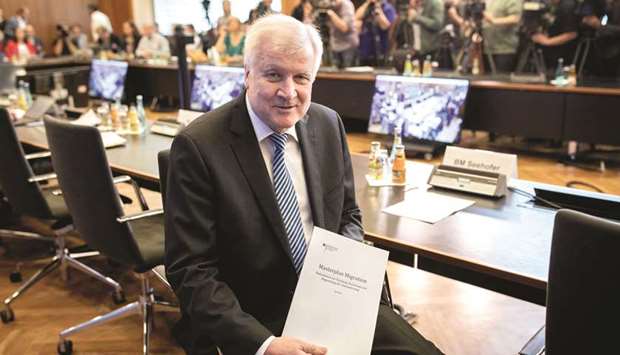
Seehofer, who leads the more conservative German coalition partner, the Bavaria-based Christian Social Union (CSU), had originally hoped to unveil his 63-point master plan four weeks ago, but delayed this when Merkel expressed concerns about plans to unilaterally turn some migrants away at the German border.
Hardliner Seehofer has often sparred with his long-time ally, Merkel, regarding migration policies, ever since he took issue with her open-door approach to the massive wave of almost 1mn migrants, largely escaping conflict in the Middle East and Africa, who arrived in Germany in 2015-6.
“This master plan is part of the asylum reversal that is urgently required for Germany,” Seehofer said as he presented the plan in Berlin yesterday.
Seehofer spoke of a “new border regime” at the German-Austrian border to prevent asylum-seekers who have already applied for asylum in another EU country from entering Germany.
He also said that migrants would be expected to co-operate on the re-examination of their applications should the situation in their homeland change, for example, or face sanctions.
The plan offers development assistance to certain partner countries in the form of a “Marshall Plan for Africa”, with the aim of encouraging potential migrants to remain in their home countries by improving economic conditions there.
Sanctions on those convicted of crimes and greater co-operation from asylum-seekers on establishing their identity will be stricter.
Any applicant claiming to be under threat in their home country who then returns to that country during the procedure will have their application rejected.
Legal procedures for dealing with appeals by asylum-seekers against a negative decision are to be speeded up.
A key aim is to prevent “secondary migration”, where an asylum-seeker makes application in one EU country and then moves to another.
EU external borders should be better protected, with migrants rescued in the Mediterranean moved to embarkation platforms in North Africa – although no North African country has agreed to this.
Those arriving in the European Union should go to “controlled facilities”, although here again the details are not clear.
Seehofer spoke of “transit centres” on presenting the policies yesterday, language that is sure to ruffle feathers in the centre-left junior coalition partner, the centre-left Social Democrats (SPD), members of which reject the idea of closed facilities.
“Repetition of this circus turns it into a farce,” said senior SPD lawmaker Ralf Stegner.
The main opposition party in the Bundestag, the anti-immigration Alternative for Germany, was sharply critical of the plan.
Party leader Alexander Gauland said it meant no change at all in migration policy.
The SPD’s leadership said yesterday that Seehofer should stop trying to renegotiate their coalition deal and stick to what has already been agreed.
He should stop putting on his summer theatre productions, they said.
Seehofer said he would seek clarity on which EU countries would enter into a bilateral agreement with Germany about taking back refugees registered in those countries.
The interior minister said he expected “difficult conversations,” but that they could succeed.
“The less Europe is able to do, the more important national measures become,” he said.
The inclusion of bilateral agreements was necessary to gain the approval of the other coalition partners, including Merkel’s Christian Democrats (CDU).
German officials were in Athens yesterday to discuss such a deal, DPA learned from sources in the Greek migration ministry, while Seehofer and his Italian counterpart Matteo Salvini were expected to discuss the issue in Innsbruck today ahead of an EU interior ministers’ meeting in the Austrian city.
On a side note, Seehofer noted with satisfaction yesterday that 69 Afghans had been deported on his 69th birthday.
At the news conference to launch his migration master plan, Seehofer claimed credit for an increase in the pace of deportations of rejected asylum-seekers.
“Just on my 69th birthday – and I didn’t request it – 69 people were sent back to Afghanistan,” he said. “That’s way above earlier levels.”
The German interior ministry announced yesterday that the number of asylum applications in the first six months of 2018 had dropped by 16% compared to the same period in 2017, to 93,316.
In the same period, the Federal Office for Migration and Refugees made decisions in 125,190 cases, a 69% drop from a year ago. Some 36% of cases were rejected.
Meanwhile, German public opinion is against the government: 72% of people surveyed by YouGov find Germany’s migration policies slipshod.
Meanwhile, only 5% find them too strict and 12% just right, the survey published yesterday found.