


Two leading eurosceptic ministers have quit Prime Minister Theresa May’s Cabinet, calling into question her ability to deliver the vision of continued close ties with the European Union that she said they had agreed to last week.
May’s office said it had accepted Foreign Secretary Boris Johnson’s resignation yesterday, hours after Brexit minister David Davis, in charge of exit negotiations with the bloc, quit on Sunday night.
The two departures shatter May’s own proclamation of Cabinet unity last Friday, when she believed she had, after two years of wrangling, secured agreement on Britain’s biggest foreign and trading policy shift in almost half a century.
May’s spokesman said she would fight any attempt to unseat her over her Brexit plan, which was welcomed by business leaders but angered leading Conservative eurosceptics by proposing to keep Britain closely aligned with EU regulations in goods trade, although not services — Britain’s main export sector.
May addressed parliament minutes after her office announced Johnson’s departure, saying: “In the two years since the referendum, we have had a spirited national debate, with robust views echoing around the Cabinet table as they have on breakfast tables up and down the country. Over that time, I’ve listened to every possible idea and every possible version of Brexit. Mr Speaker, this is the right Brexit,” she said, to jeers from the opposition Labour Party.
In resigning on Sunday, Davis called May’s plan “dangerous” and said it would give “too much away, too easily” to EU negotiators.
May replaced him with another Brexit campaigner, junior minister Dominic Raab.
The departures were likely to fuel a noisy rebellion among Conservative Brexit campaigners who say she has betrayed a promise to pursue a clean break.
But her speech in parliament signalled that, after finally nailing her colours to a vision of Brexit, she had decided to face down the dissenters, who probably do not constitute a majority of Conservative members of parliament.
She was welcomed with applause and cheers as she arrived at a meeting of the Conservatives’ 1922 Committee of lawmakers.
May also urged the EU to engage with her Brexit proposal or risk Britain crashing out of the bloc without a deal.
“What we are proposing is challenging for the EU, it requires them to think again, to look beyond the positions they have taken so far and agree a new and fair balance of rights and obligations,” she told parliament.
With less than nine months left before Britain is due to leave the EU, and just over three before the EU says it wants a deal, European Council president Donald Tusk raised the idea that Brexit might be called off.
“Politicians come and go but the problems they have created for people remain,” he tweeted.
“I can only regret that the idea of Brexit has not left with Davis and Johnson. But...who knows?”
May had been reluctant to spell out her strategy until now precisely for fear of igniting furious rows in her deeply divided Conservative Party.
Many eurosceptics accused her of siding with the “Remainers” in her Cabinet — those who voted in 2016 to stay in the EU and have demanded a Brexit that would preserve the complicated supply chains used by many of Britain’s biggest companies.
They fear a clean break would cost jobs.
But the ardent Brexit supporters say the deal May is now proposing to negotiate could leave Britain still accepting EU rules and regulations, but without being able to influence them.
“It’s imperative we do Brexit right, no half measures!” tweeted Scottish Conservative lawmaker Ross Thomson.
May insisted that her proposals would honour the will of the British people, as expressed in the In/Out referendum, by ending free movement of people, the jurisdiction of the European Court and “vast” payments to the bloc. “This is not a betrayal... I believe that is what people voted for when they voted to leave and we will deliver in faith with the British people,” she said.
She said she would now focus on moving the exit negotiations on — a step EU officials and businesses have long called for.
And she reiterated her position that there would not be a referendum on the final deal to leave the European Union, or any attempt to put back the exit date of March 29, 2019.
But it is still not clear whether the EU will accept her negotiating bid on a free trade area for goods.
Brussels is determined not to allow Britain to “cherry-pick” elements of EU membership, which might encourage other countries to follow it out of the door.
Rebellion spurs new push for ‘People’s Vote’ on final deal
As two leading pro-Brexit rebels resigned from Prime Minister Theresa May’s Conservative government, pro-EU lawmakers from all parties launched a new push for a “People’s Vote” on any final deal agreed for Britain to leave the EU in March.
“The government must recognise the reality: We are not, and will not be, ready in time,” tweeted Phillip Lee, a pro-EU Conservative who resigned from his post as a junior justice minister last month.
“It’s not good enough belatedly to plan for no deal,” Lee wrote, urging the government to suspend the Brexit process to allow time to “define the options clearly.” “Then we need a new vote to get our people’s informed consent before we proceed,” he said.
Another pro-EU Conservative, Sarah Wollaston, claimed Brexit had been “sold on a false prospectus.”
“As parliament is not now going to have a meaningful final vote, people should be able to give their own verdict on the deal,” Wollaston tweeted, adding the hashtag .peoplesvote.
Opposition Labour lawmaker David Lammy said the government was split over Brexit and “the nation is more divided than ever,” asking May in parliament if she would support another vote.
“The reason I will not commit to that is because the people voted,” May replied, referring to the Brexit referendum in June 2016, when a majority of 52% voted to leave the European Union.
“They made clear their choice and they want their government to deliver on that choice,” she said.
May urged Labour, which has no fixed policy and remains divided over a second vote on Brexit, to rule out supporting one.
Labour’s Chuku Umunna, a leading supporter of the People’s Vote campaign, said the sharp division over May’s latest Brexit proposals showed that another vote was needed.
Liberal Democrat leader Vince Cable said Johnson’s resignation “completely destroys the Conservative position.”
“It’s not too late. We can exit from Brexit,” Cable tweeted, urging supporters to add their names to an online petition already backed more than 200,000 people.
Umunna, Cable and other pro-EU politicians attracted tens of thousands of supporters to a People’s Vote march in central London on June 23, the second anniversary of the referendum.
Meanwhile, Labour leader Jeremy Corbyn accused Prime Minister Theresa May of being incapable of negotiating a Brexit deal with the European Union given the deep splits among her own ministers over her plans.
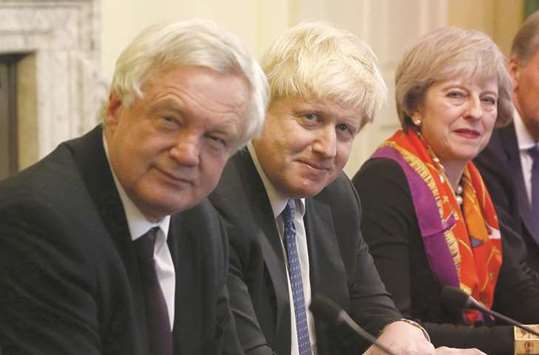
May, David Davis (left) and Johnson: departures shatter PM’s claims of Cabinet unity.