


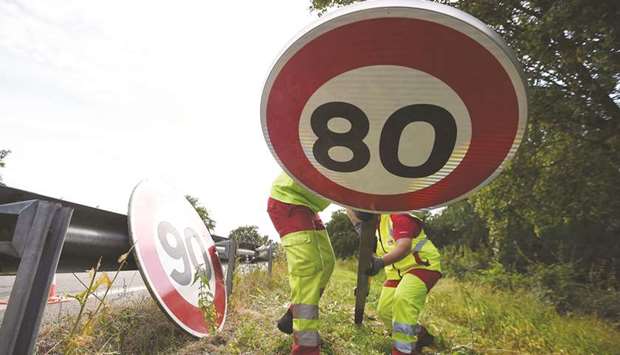
So when officials chose three stretches of the road back in 2015 to test lowering the speed limit to 80kph (50mph) from 90kph, they surely knew they would rankle motorists.
Three years later some drivers have swung behind the change, but many others are still fuming.
“Yesterday I was going at 80 and it felt like I was going to fall asleep,” said Gerard Laguette, a local business owner in Croze-Hermitage, referring to the lower limit while driving on a 20km run to Valence in southeast France.
Such complaints – and opinion polls showing 74% of respondents against the move – did not stop President Emmanuel Macron from pushing ahead with a countrywide rollout of the lower speed limits on July 1.
Officials say that it’s the only way to reverse an alarming rise in road deaths, which reached 3,684 last year.
The 80kph on 400,000km of two-lane roads with no separating guardrail – often lined with trees in many parts of the country – aims to save 400 lives a year while also reducing auto emissions by 30%.
However, critics deride the measure as “Paris snobbery” and the latest proof that Macron is the “president of the rich” with little regard for the concerns of ordinary voters.
The 40-year-old former investment banker has recently come under fire for blasting the “crazy amounts of dough” spent on social security, even while ordering pricey new presidential china and a private pool for his official vacation residence.
He has also raised taxes on pensions and pushed through laws making it easier for firms to fire workers, while slashing taxes for high earners.
The lower speed limit is widely seen as an easy way to fill state coffers with more tickets.
The government “prefers tech-savvy city cyclists to country people driving diesels”, Vincent Descoeur, an opposition Republicans lawmaker, said in parliament this month.
The government launched TV and radio campaigns to try to quell motorists’ anger, saying that the new limits would add only a few minutes to most trips while cutting a driver’s petrol costs by €120 ($140) a year.
A 10km trip, for example, would take 45 seconds longer, or just two minutes more for a 25km drive.
“The goal is not to piss people off,” Prime Minister Edouard Philippe said late last month, reiterating that he is ready “to live with being unpopular”.
He said a similar reduction on the Paris ring-road a few years ago led to an 18% drop in accidents.
He also has promised that any spike in speeding fines will be allocated to caring for car crash victims.
Yet some local officials have vowed they won’t put up the new signs, even though Philippe has promised to reimburse municipalities for the expected total cost of €6mn-€12mn.
For Mathieu Flonneau, a French transport historian, even though the government has logic on its side, it risks appearing dismissive of the millions in rural areas who rely on their cars for work.
“If this measure is seen as leaving behind regions which are already on the margins of French society, it will be a sore point for many,” he told AFP.
Critics say that is exactly what’s happening.
“The prime minister is trying to project an image of authority. It’s a Parisian reform, with no regard for people who drive every day,” said Pierre Chasseray of the 40 Million Drivers advocacy group.
“This will be a political millstone they’ll have to carry,” he said.