


Austrian Chancellor Sebastian Kurz said yesterday that his government would use its EU presidency to make the bloc safer, adding that the country wanted to “be a bridge builder in the EU [and] to reduce tensions within Europe”.
Speaking at a summit in the town of Schladming to mark his country taking over the rotating presidency on July 1, Kurz said his government would promote “a Europe that protects” during the six-month period.
The presidency will give Austria – governed by a coalition that includes the far-right Freedom Party (FPOe) – the opportunity to set the agenda as the bloc grapples with an influx of migrants and the management of its internal and external borders.
Kurz’s government has a hardline stance on irregular migration, and has aligned itself with right-wing governments in countries including Poland and Hungary in demanding a more restrictive EU policy.
“The desire for security, as old as mankind itself, manifested itself with full force during the migration crisis,” European Council President Donald Tusk said in Schladming as he oversaw the proceedings.
EU leaders hammered out a deal during a summit in Brussels on Thursday and Friday that foresees migrant processing centres in Africa as part of the solution to a row over how to handle migrants heading for European shores.
The Austrian chancellor told public broadcaster ORF late on Friday that an EU-Africa summit is on the cards for later this year.
Until then, he added, it’s important for individual EU states to use their connections with African countries to find a solution to the European asylum question.
He specifically named Italy and Libya, as well as Spain and Morocco.
The EU states are looking into the possibility of setting up “controlled” processing centres where migrants picked up while trying to cross the Mediterranean could be taken, with the UN’s refugee agency UNHCR determining their asylum status.
The International Organisation on Migration (IOM) would offer support to those denied asylum status in their homeland under this plan.
Both organisations have stressed that the EU should focus however on setting up such centres in European countries, rather than in Africa, and that they were willing to co-operate on Europe-based facilities.
As part of the deal reached by EU leaders after marathon talks on Thursday, the foreseen centres in Europe would be hosted by member states on a voluntary basis.
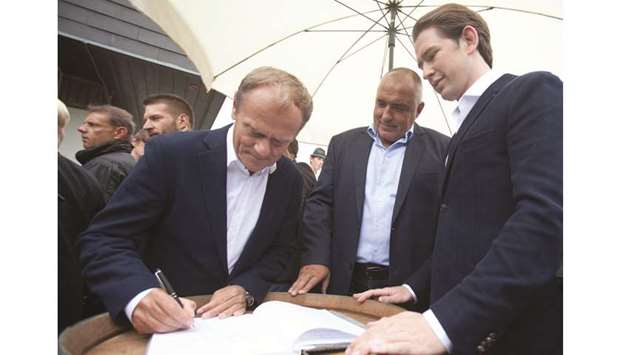
European Council President Donald Tusk signs the Mount Planai summit book in front of the cable car station next to Kurz (right) and Bulgarian Prime Minister Boyko Borisov during a kick-off event for the Austrian EU Presidency on the Mount Planai, in Austria. Austria takes over the European Union’s rotating presidency today.