


The Gardens of Al-Andalus exhibition opened yesterday at the Qatar National Library (QNL) in Education City, highlighting the importance of gardens in Islam and displaying the plants, tools and gardening methods used by Muslims in Andalusia.
The three-month exhibition, created by the Islamic Culture Foundation of Madrid (Funci) and being held under the patronage of HE Sheikha Hind bint Hamad al-Thani, Chairperson of the Board of Trustees, QNL, will run until September 7. “What we want to promote, what we want to explain here is that in the Islamic culture there is a duty, the obligation of taking care of nature,” Funci secretary-general Encarna Gutierrez told reporters.
“Taking care of the environment is very normal in Europe and the Western countries,” she said. “But this was already in the Islamic culture in the Medieval ages.”
Al-Andalus generally refers to the area of the Iberian Peninsula governed by Muslims from the 8th century to the 15th century, which gave its name to the modern region of Andalusia in southern Spain, according to Funci. The Qur’anic Botanic Garden brought the exhibition to Qatar after it was shown in various countries in the Mediterranean and the Arabian Gulf.
The exhibition is part of Funci’s ‘Med-O-Med, Cultural Landscapes of the Mediterranean and the Middle East’ network, a platform spanning 23 countries aimed at the preservation of the region’s natural and cultural heritage, as well as development and education.
Gutierrez said they are now talking with Qatari authorities to have an Al-Andalus garden in the country as part of a bigger project. In conjunction with the exhibition, QNL has uncovered various manuscripts, photographs and rare books related to the topic. The show displays multiple scale models depicting the most significant gardens of Al-Andalus, as well as numerous olfactory devices, which allow one to sample some of the botanical species, used at the time.
The exhibition recreated a series of 3m tall towers displaying botanic species, historical drawings and the ancient botanical sheets that reference Al-Andalus’ gardens, orchards, and properties.
The towers evoke the wind towers common in the traditional architecture of the Arabian Peninsula, which were used to naturally cool and ventilate buildings.
According to Funci, the models represent the different types of Andalusian gardens, as well as water mills. “Gardens and the natural world are an important part of Islam, and the gardens of Andalusia represent a unique blend of Arabic and European cultures,” QNL executive director Dr Sohair Wastawy said in a statement.
“This exhibition explores the botanical, architectural, scientific, spiritual, and artistic aspects of these gardens to present a holistic view of these important cultural and historical creations,” she added.
Ada Romero Sanchez, special collection and exhibitions co-ordinator at QNL, said the exhibition presents the library’s visitors with an opportunity to learn about the Islamic civilisation’s unique approach to preserving nature.
“The design and content of the exhibition also allow visitors to learn about the historical interconnections between Spain, Qatar, and the wider Muslim world,” Sanchez noted. “We invite everyone to visit the exhibition and also make use of the Library’s wealth of other resources.”
Funci president Dr Cherif Abderrahman Jah said Al-Andalus was a veritable laboratory for the study and dissemination of the Islamic sciences, inspired by the Holy Qur’an, and one of the greatest examples of peaceful co-existence between cultures.
“As a result, Funci sees the Al-Andalus garden as a metaphor which can serve to regain the seed of the values inherent in Islam, and invites all Muslims, in this holy month of Ramadan, to rethink the message in the Qur’an and to acknowledge the value of the Ummah and the need to restore its balance,” Dr Jah added.
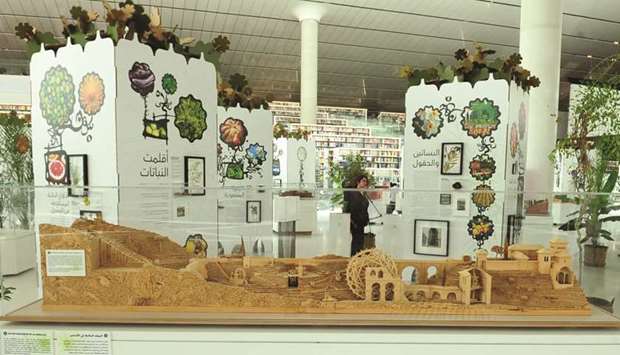
The exhibition displays multiple scale models depicting the most significant gardens of Al-Andalus. PICTURES: Nasar T K