


Franklin Templeton Investments is taking advantage of bouts of volatility in emerging markets to add to holdings of Gulf bonds and global Islamic securities as it expects the US 10-year yield to fall back.
Many of the six-nation Gulf Co-operation Council members have implemented economic reforms which “are beginning to bear fruit” after the slide in oil prices that began in 2014 eroded their wealth, said Mohieddine Kronfol, the chief investment officer for global sukuk and Middle East and North Africa fixed income at Franklin Templeton. He is also optimistic on Islamic bond issuers such as Malaysia, Indonesia and Nigeria.
“The operating environment for many of the credits that we’re looking at is likely to improve going forward rather than deteriorate,” Kronfol said in an interview in Dubai. “Having been defensive over the past 18 months, we are predisposed to want to increase risk.”
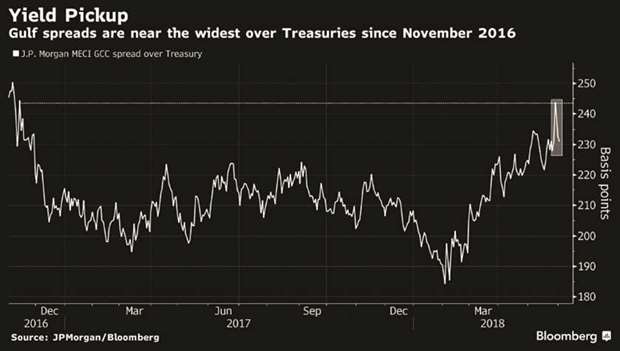
The spread on Gulf bonds over Treasuries fell for a fourth day Monday to 227 basis points, after reaching 244 basis points last week, the highest since November 2016, according to a JPMorgan Chase & Co gauge.
There’s a tendency for investors to overestimate the growth outlook of the US relative to other economies, and the Federal Reserve’s ability to raise rates, Kronfol said. The Treasury 10-year yield may decline in the next six months to about 2.5%, a level last seen in January, he said.
US inflation data may disappoint and lead the Fed to slow down the pace of interest-rate increases, Kronfol said, while US politics and the threat of trade wars will also influence policy makers at some point. The benchmark yield was at 2.91% at 8.23am in New York, after peaking at 3.126% on May 18.
“When you have moderate growth and significant sources of risk or potential risks, in my mind this is still fairly conducive for fixed income,” he said. “That keeps us comfortable holding on to some duration.”
The dollar will also eventually weaken, according to the manager. Much of the greenback’s strength in recent months was tied to “short-term technical factors,” including significant repatriation of dollars following sweeping changes to the US tax system, he said. A gauge tracking developing-nation currencies has retreated about 3% since reaching an all-time intraday high in March.
“We find value in many of these emerging-market currencies,” Kronfol said. About 10% of the fund’s holdings are in currencies other than the dollar. They include Malaysia’s ringgit, Indonesia’s rupiah and Nigeria’s naira.
Here are Kronfol’s views on the market:
n GCC debt sales, including sukuk offerings, by governments and companies in the Gulf this year will probably amount to around $80bn, down from the record raised in 2017.
n Offerings are set to slow in the summer and pick up toward year-end after borrowers raised more than $50bn in the first half.
n “That’s really driven by our expectations that budget deficits are decreasing and we should see slightly lower issuance. But if the operating environment does improve and risk premia remain modest, you could see corporates and banks come to the market and issue. Our number could be conservative”.
n Sukuk sales are set to continue growing by 10% to 15% this year, with issuance from Southeast Asia and debut offerings from countries such as Morocco, Kenya and Tunisia.
n In Islamic finance, outside the Gulf, Franklin Templeton will continue to have significant positions in Malaysia and Indonesia.
n Indonesia has benefited from rating upgrades in recent years, in contrast with many other developing countries that have been downgraded.
n Franklin Templeton is “becoming increasingly optimistic about the outlook for Malaysia,” even though Mahathir Mohamad’s surprise election victory will lead to some short-term volatility.
n “In the Islamic finance industry, Malaysia has a very prominent role. It’s going to go through some invigoration and possibly change in policy, a lot of which could set it on a path for slightly higher growth than we’ve seen.”
.