


MRV’s not offering rooftop pools at its newest development, but it is making a high-end bet on Brazil’s low-income population.
The world’s third-largest homebuilder, MRV Engenharia e Participacoes SA is working on its biggest development yet: It’s investing 1bn reais ($236mn) in a project that will include daycare, tree-lined public spaces and underground electric lines. Reserva Paulista, with 7,000 apartments and within walking distance from the train in Sao Paulo, is aimed at the working class.
It may sound ordinary in the developed world, but those are considered big-time amenities in a country where low-income housing is usually poorly built, with tiny spaces and unfinished floors, and 5% of the population lives in favelas, or slums.
MRV’s strategy to offer well-thought public spaces with saleable building techniques in convenient locations is an effort to turn their apartments into objects of desire, and not simply the most affordable option – though at $65,000 for a two-bedroom, 650-square-foot apartment with parking, they are that, too. To put it into perspective, an apartment that size without parking would cost about $500,000 in Bedford-Stuyvesant, Brooklyn.
“I can’t allow this to become a tenement in 10 years,” co-chief executive officer Eduardo Fischer said in an interview at the Reserva Paulista site, scheduled for completion in 2022. “We need to make a process of ‘unshutting people away.’”
More than 11mn people lived in favelas in 2010, according to the latest data available from Brazil’s geography and statistics institute IBGE. In Sao Paulo alone, more than 350,000 units are needed to end the housing deficit, according to city government. And squatting is rampant – on May 1, a 24-story building occupied by 150 homeless families collapsed after a fire started by a short circuit amid miles worth of illegal electric connections. Four people were killed and, almost two weeks later, firefighters are still looking for bodies.
MRV’s project, from burying wires to teaching condo managers to focus on maintenance to avoid later problems, is an attempt to transform a culture of negligence and build a lifelong relationship with buyers.
“Thirty-eight years ago, I would hand the keys to the buyer and walk away,” Fischer said. “That has changed. My relationship with my client will continue 10 or 15 years after he gets into his apartment.”
The company announced in December that it would start building “premium” condos, targeting its customers when they are ready to trade up.
MRV says that one in every 200 Brazilians lives in its 300,000 apartments. That should increase as the company speeds up construction to 50,000 units per year from 49,500 units in 2017, using moulds to build concrete walls, which lowers costs. “We’re almost as fast as McDonald’s making burgers,” Fischer said. “We hand over an apartment key every two and a half minutes.”
The Belo Horizonte-based company said last week that revenue jumped 21% in the first quarter from a year earlier. Despite a slow start in new projects, Fischer said MRV will meet their 2018 target and demand is picking up.
“I’ve noticed a more intense search for real estate and faster deal closings,” Fischer said. “The economy hasn’t improved much, but the climate has.”
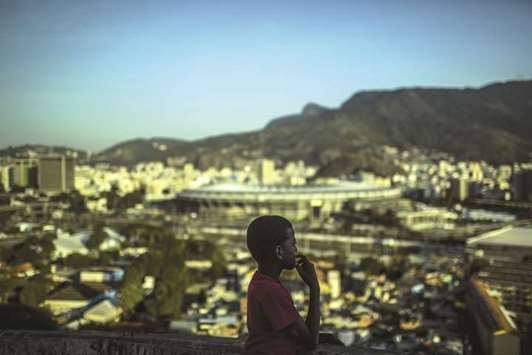
A child looks out from a rooftop in the Mangueira favela, as the Maracana Stadium stands in the background during the 2016 Olympics in Rio de Janeiro (file). MRV is not offering rooftop pools at its newest development, but it is making a high-end bet on Brazil’s low-income population.