


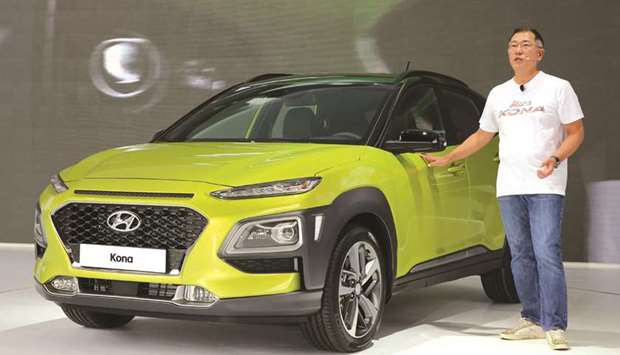
After announcing about 1.6tn won ($1.5bn) in buybacks and stock cancellations in the past month, shareholder returns are “just beginning,” vice chairman Chung Eui-sun, the 47-year-old son of the group’s octogenarian patriarch, said in a rare impromptu interview at a Hyundai innovation centre event in Seoul this week. “Our shareholder policies unveiled so far are not everything we have.”
The founding family has much riding on the support of investors in the coming weeks. On May 29, they’re scheduled to vote on a reorganisation of the group, including a controversial $8.8bn merger that could pave the way for Chung to ascend to the top. Problem is billionaire Paul Singer’s Elliott Management Corp, which bought more than $1bn of shares in group units, has embarked on a campaign to derail the deal based on claims that it will shortchange minority shareholders.
Instead of management’s proposal – whereby parts-maker Hyundai Mobis Co would spin off its biggest profit-generating businesses and merge them with a logistics affiliate – the US fund proposed that Mobis merge with flagship Hyundai Motor Co to form a holding company that would oversee the conglomerate.
It also proposed that group units return more than $11bn in excess cash to shareholders, raise dividends, cancel treasury shares, add independent directors and improve governance. Hyundai Mobis shares rose 2.4%, the most since April 4, to close at 237,000 won in Seoul, while the benchmark Kospi index rose 0.6%.
Chung said he wasn’t fazed by Elliott.
“That’s the way they do business,” Chung said. “We will listen carefully and if there are proposals that bring benefits to our company and other shareholders, we will review some of that.” Though Chung acknowledged that Mobis needs to do more to win over shareholders, he said his broader plan for the group centres on transforming Mobis from a simple parts maker to a cutting-edge, technology-centred automotive supplier that would challenge Germany’s Robert Bosch GmbH and lead the entire group in profits.
That way, earnings would rise and returns for investors would increase, creating a “virtuous cycle,” he said.
“The best shareholder friendly policy is for us to make money, pay lots of dividends so that could boost the value of our company,” Chung said.
Fundamentally, Mobis needs to become a leader in automotive technologies such as camera sensors, autonomous driving,
connectivity and electrification, Chung said. Developing software, artificial intelligence and robotics are also high on the priority list, he said.
The company is looking at four to five possible acquisition targets as part of efforts to make Mobis grow, Chung said.
But the proposed reorganisation calls for Mobis to play another key role: help the founding family’s ability to control a sprawling collection of 56 companies with more than $200bn in assets.
Under the proposal, the Chung family would build its stake in Mobis, which would act as the group’s de-facto holding company. For the vice chairman, selling his Hyundai Glovis Co shares would provide the means to bankroll his purchases of Mobis stock, which is why the merger is of particular importance for the heir apparent.
The plan calls for Mobis to effectively sell its most profitable operations, which analysts have said would allow Glovis to bulk up in size and pave the way for Chung to fetch more for his shares.
Case in point: The value of Chung’s 23% stake in Glovis jumped almost 20% to 1.6tn won within three weeks since the group’s reorganisation deal emerged, though those gains have largely evaporated after Elliott began its opposition campaign.
Elliott has cried foul on the merger, arguing that Mobis would be unloading key assets at a discount and questioning the logic behind combining an after-sales business with a logistics company.
Hyundai has said that the combination would create synergies and that the offer was fair based on Korean rules.
Elliott said in a statement Thursday that it will vote against Hyundai’s restructuring as proposed because the company has failed to provide a sound business rationale for it, offer fair terms to all shareholders, or simplify its corporate structure.
The plan also fails to address Hyundai’s valuation discount and to optimise its balance sheet, Elliott said.
While Elliott acknowledged Hyundai has announced some “token measures” on share buybacks and cancellation of some existing treasury shares, it encouraged shareholders to vote against the plan.
“While Elliott believes this is a positive development, more significant measures are needed to address the long- unresolved issues at the group that have led to significant valuation discounts and underperformance at Hyundai Mobis, Hyundai Motor Co and Kia,” it said. The fund is no stranger to Korea.
In 2015, it challenged a controversial merger between two units at Samsung Group, the country’s biggest conglomerate, before narrowly losing in a proxy fight.
The contested merger, which solidified the control of Samsung’s founding family over the group, played a key role in a series of events that led to the jailing of Samsung’s de- facto leader and the impeachment of the country’s president.
Elliott is now seeking at least $670mn compensation from the government for meddling in that deal.
The ouster of the president opened the door for left- leaning Moon Jae-in to sweep into power by vowing to break the cozy ties between politicians and the nation’s family-run conglomerates, locally known as the chaebol.
Moon brought in two former shareholder activists, Jang Ha-sung and Kim Sang-jo, as top members of his administration but that hasn’t necessarily turned into an advantage for Elliott.
Kim, now the nation’s top fair trade official, recently criticised some of Elliott’s proposals as being unfair.
Back at Hyundai, one Elliott demand that Hyundai’s Chung appeared to embrace were calls to make the boards at group units more independent and diverse.
Chung said he plans to strengthen the boards at individual units, distancing them from past practices whereby strategic decisions were generally made by the group chairman.
Chung said he’s “very welcoming” to the idea of bringing in foreigners and women on his boards.
The Hyundai scion, who studied business at the University of San Francisco and at Korea University, has steadily been making his mark at the automotive conglomerate since he was promoted from president of Kia Motors in 2009.
For one, he brought in a slew of foreign talent such as Audi TT designer Peter Schreyer, ex-Bentley design chief Luc Donckerwolke and former BMW M performance brand chief Albert Biermann.
Chung also launched Hyundai’s luxury Genesis brand and high-performance N series.