


Turkish consumer price inflation jumped more than expected in April, data showed yesterday, sending the lira to a record low on concern about the central bank’s failure to rein in prices.
Inflation climbed to almost 11% year-on-year, stoked by the lira’s fall of some 10% against the dollar this year.
Double-digit inflation is Turkey’s most pressing economic problem as President Tayyip Erdogan and his ruling AK Party head into elections on June 24.
Erdogan has repeatedly called for lower borrowing costs to fuel loan growth and boost the economy.
“Inflation is high, inflation could accelerate, the central bank is behind the curve,” said Guillaume Tresca, a senior emerging markets strategist at Credit Agricole. “They don’t have enough room to manoeuvre ahead of the elections.”
The consumer price index climbed 1.87% month-on-month, the Turkish Statistical Institute said, above a Reuters poll forecast of 1.6%, for a rise of 10.85% year-on-year.
Core inflation, which excludes volatile food and energy prices, was 12.24% year-on-year.
Sentiment toward Turkish assets had already been hit this week, after Standard & Poor’s cut Turkey’s sovereign rating further into junk territory and a survey showed manufacturing contracted last month.
The S&P move, and the government’s announcement of a $6bn incentive package of debt restructuring and social reforms ahead of the election, “reignited market concerns about the overheated economy at a time when inflation is rising”, said Piotr Matys, a London-based Rabobank strategist.
The lira, one of the worst-performing emerging market currencies this year, weakened to a record low of 4.2487 against the dollar, from Wednesday’s close of 4.1785. It was at 4.1990 at 1257 GMT.
The main share index dipped 0.35% and the yield on the benchmark 10-year bond rose to 13.25% from 12.93% on Wednesday.
The cost of insuring Turkish debt against default also rose.
“The underlying fundamental problems have not been resolved, otherwise we would be loading up the boat with Turkish lira bonds,” said Viktor Szabo, portfolio manager at Standard Life Aberdeen. “Let’s face it, these guys are not going to default.
The only issue is what level the lira will be at when you do get repaid.”
The economy is expected to expand 4.1% this year, a Reuters poll showed last month, below both the 7.4% expansion in 2017 and the government’s target of 5.5%.
“Turkey’s economy is overheating,” S&P warned in its downgrade this week. “We believe the Turkish government will continue to push the economy, accepting the buildup of imbalances until parliamentary/presidential elections.”
Last week, the bank raised its top interest rate by a more-than-expected 75 basis points but analysts said it would need to do more to fight inflation and support the currency. Its next policy-setting meeting is on June 7.
“Unless quite substantial tightening of monetary policy is delivered, the lira will remain volatile,” Rabobank’s Matys said, adding the central bank may have to consider an emergency policy meeting beforehand, as was the case in January 2014.
The bank on Monday lifted its end-2018 inflation forecast to 8.4%, when it announced its quarterly inflation report.
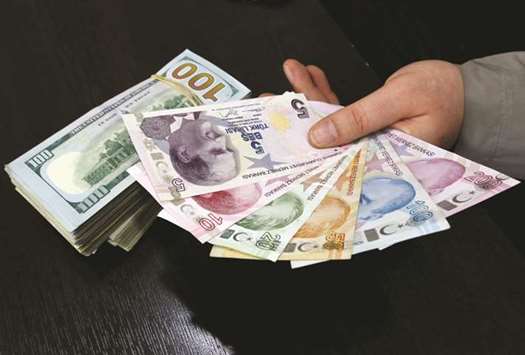
A money changer holds Turkish lira banknotes next to US dollar bills at a currency exchange office in central Istanbul (file). Turkish consumer price inflation jumped more than expected in April, data showed yesterday, sending the lira to a record low on concern about the central bank’s failure to rein in prices.