


Two Qatari electrical engineering students, who are graduating from Texas A&M University at Qatar (Tamuq) this year, have spoken of their life-changing internships with Cern, the largest research centre in the world for high energy physics.
Qatari brother and sister Abdulaziz al-Qahtani and Shaikha al-Qahtani spent eight weeks in Cern, the European Organisation for Nuclear Research. Joining the day-to-day work of research teams participating in cutting-edge experiments in Geneva, Switzerland, the siblings say they are determined to further engage in research-driven programmes.
The al-Qahtani siblings were chosen out of 7,000 student applications, and were the only Qatari participants among the 340 individuals accepted on to the programme. During the internship, Abdulaziz worked on Cern’s large particle detector, the Compact Muon Solenoid (CMS), located across the border in France. The CMS experiment is one of the largest international scientific collaborations in history.
“When I was at Cern, I saw the powerful impact of shared research initiatives, and this was a wakeup call for me. Before, I had just wanted to finish university, find a job, get experience, and then perhaps continue my studies. Now I realise research is the future,” said Abdulaziz.
“In the end, you will never run out of brain power, but you may run out of other resources. While Cern is not a business, it is a sustainable research-driven committee. So this is why I now think most of the sustainable income in Qatar should come through collaborative research.”
Shaikha, on the other hand, worked on the Large Hadron Collider Atlas detector, the largest volume particle detector ever constructed, which aims to discover new particles and find answers to several unanswered questions in the field of physics. The detector is located 100 metres below ground near the main Cern site.
“At Cern, I worked with the University of Bologna, one of the leading academic institutions in Italy and Europe,” said Shaikha. “I had three mentors, and each of them had their own specialities, so whenever I needed questions answered in any field I knew who to ask. Since Abdulaziz worked on the other side of Cern, and the experiments were computed around it, we were almost like competitors.”
Abdulaziz said he was able to publish a paper at the end of his internship, thanks to the “tough love” he received at the hands of his mentor at Cern. “Not everyone published papers at this stage of the internship, especially not during their undergraduate studies. Many students held master’s degrees in different fields, and they hadn’t published papers yet,” he said.
Beyond the scientific value of their stay, the students had the opportunity to network with multicultural teams, attend lectures, visit Cern facilities, and take part in discussions and workshops with people who are leaders in their fields. “I interacted with people from different cultures, and they were all working together to achieve one goal,” said Shaikha.
Abdulaziz agreed, saying the opportunity to network with various professionals was one of the highlights of the internship experience, and that collaboration was possible “because when it comes to science, politics takes a back seat.” Both students said they are now inspired to pursue their master’s degrees and PhDs as a result of their internship experiences at Cern.
In 2016, Qatar Foundation signed an international co-operation agreement with Cern, which outlined long-term collaborations and future opportunities between engineers and technicians from Qatar in research projects at Cern. Dr Othmane Bouhali, research professor and director of research computing at Tamuq, leads the university’s activities with Cern, where he has worked for more than 20 years.
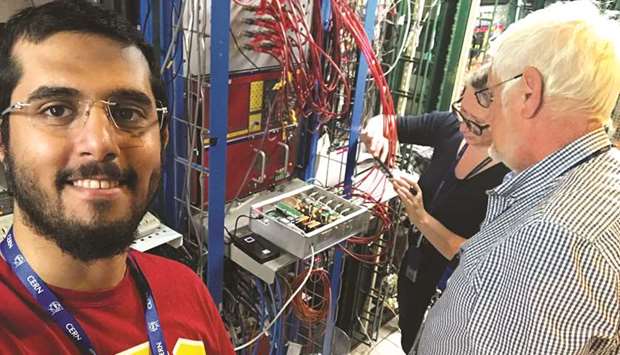
Abdulaziz al-Qahtani