


Alfie Evans, the 23-month-old British toddler whose grave illness drew international attention, died early yesterday, his family said.
Evans had a rare, degenerative disease and had been in a semi-vegetative state for more than a year.
After a series of court cases, doctors at Alder Hey Children’s Hospital in Liverpool removed his life support on Monday, against his parents’ wishes.
He confounded expectations by continuing to breathe unaided for days, but died in the early hours of yesterday, his parents said.
“My gladiator lay down his shield and gained his wings at 2.30am. Absolutely heartbroken,” the boy’s father Thomas Evans wrote on Facebook.
“Our baby boy grew his wings tonight ... thank you everyone for all your support,” his mother Kate James wrote.
Medical experts in Britain had agreed that more treatment for Evans would be futile, but his parents wanted to take him to Rome, where the Vatican’s Bambino Gesu hospital had offered to care for him.
A British court rejected an appeal by the parents on Wednesday to take their son to Italy.
The case stirred strong feelings over whether judges, doctors or parents have the right to decide on a child’s life.
Alfie’s parents were supported by Pope Francis and Poland’s President Andrzej Duda.
“I am deeply moved by the death of little Alfie. Today I pray especially for his parents, as God the Father receives him in his tender embrace,” the Pope tweeted yesterday
Alder Hey Children’s hospital expressed their condolences.
“All of us feel deeply for Alfie, Kate, Tom and his whole family and our thoughts are with them. This has been a devastating journey for them,” the hospital said.
Supporters began to leave floral tributes outside the hospital and a post on the “Alfie’s Army” Facebook page, which has 801,000 members, said balloons would be released from a park near the facility.
Evans was born on May 9, 2016 and was first taken to hospital in December of that year after suffering seizures.
His condition worsened and, a year later, in December 2017, the hospital recommended withdrawing life support.
The parents disagreed and the two sides went to court.
At a hearing in February the hospital’s lawyers argued that Evans had suffered “catastrophic degradation of his brain tissue” and said Italian doctors who visited the child were agreed on the “futility” of trying to find a cure.
Helen Cross, an expert in child epilepsy at another children’s hospital in London, told the hearing that scans showed over 70% of the baby’s brain fibre had been lost and said there was “no prospect of recovery”.
Pope Francis intervened several times in a case that touched hearts around the world and prompted vigils in Italy and Poland.
According to the parents’ lawyer, the Pope had helped to organise a military air ambulance to transport Alfie to Rome.
Earlier this week the Pontiff wrote on Twitter that he hoped the parents’ “desire to seek new forms of treatment may be granted”.
“The only master of life, from the beginning to its natural end, is God, and our duty is to do everything to protect life,” he said.
Thomas Evans had also met with the Pope in the Vatican last week and asked him to “save our son”.
Italy granted citizenship to the toddler on Monday in the hope of facilitating his transfer to the Bambino Gesu (Baby Jesus) paediatric hospital in Rome.
After losing his legal battle, the father on Thursday had asked supporters, who have staged angry vigils outside the hospital where the baby was being treated, to go home.
Medical staff have been subjected to severe online abuse and police officers had to be deployed outside the clinic on Monday after some protesters tried to gain entry.
The case is the latest in a series of high-profile battles between parents of seriously ill children and the British authorities.
British law states that parents “cannot demand a particular treatment to be continued where the burdens of the treatment clearly outweigh the benefits for the child”.
If agreement cannot be reached between the parents and the healthcare professionals, “a court should be asked to make a declaration about whether the provision of life-sustaining treatment would benefit the child”.
The most recent example was that of Charlie Gard, who was born in August 2016 with a rare form of mitochondrial disease.
He died last year, one week short of his first birthday, after doctors withdrew life support.
Gard’s parents fought a five-month legal battle for him to be taken to the United States for experimental treatment.
The parents of Ashya King defied professionals in 2014 when they snatched their cancer-stricken son from a British hospital and took him to Prague for proton beam therapy.
King, now aged eight, has since been declared clear of the disease.
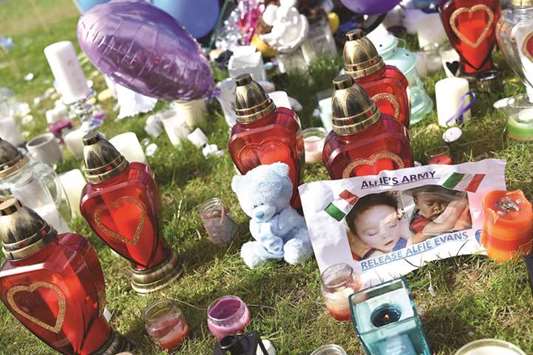
Tributes for Alfie are left yesterday outside the Alder Hey Children’s hospital in Liverpool.