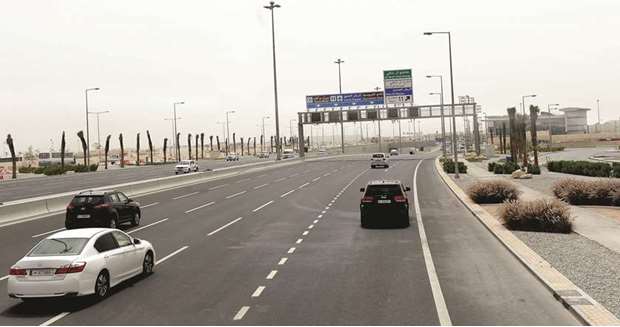
The Public Works Authority (Ashghal) has opened Bani Hajer interchange, which will provide free-flowing traffic between Doha, Dukhan, Bani Hajer and Al Rayyan.
The interchange is part of the nearly QR7bn Khalifa Avenue project.
The feeder was inaugurated by Ashghal’s Expressway Department manager Youssef al-Emadi and the Ministry of Interior’s Traffic Engineering and Safety Department manager Brigadier Mohamed Marifiya in the presence of a number of Ashghal staff members, project engineers and workers.
With the opening of the multi-level interchange in Bani Hajer, temporary diversions will be removed and traffic will be shifted onto permanent routes via the new junction. It will help reduce transit time in the area significantly, according to Ashghal.
The authorities said the previous Bani Hajer roundabout’s complete conversion into a three-level interchange will ensure free traffic movement of approximately 1,500 vehicles per hour. The intersection has become a key access point for three major arteries of Khalifa Avenue, Dukhan Road and Al Rayyan Road along with the residential areas around.
The Khalifa Avenue carriageway saw the opening of four lanes in each direction for a distance of 2.4km between Gharrafat Al Rayyan interchange and Al Wajbah Bridge, covering a total of 5.5km on Khalifa Avenue following the opening of 3.1km of the carriageway from west of the Tilted Interchange and Gharrafat Al Rayyan interchange in December last year.
Ashghal has said the opening of these vital sections “remarkably enhances” traffic movement, especially between Doha and Dukhan.
Also, the construction of a 1.3km flyover and underpass was accomplished to connect traffic heading from Al Rayyan Road towards Dukhan Road.
Two right ramps, one for receiving commuters from Doha to Bani Hajer via Khalifa Avenue and the other for travellers coming from Bani Hajer to Dukhan via Al Shahama Street, have also been opened.
Two more loops connecting Bani Hajer Underpass, too, were opened, to link traffic from Dukhan to Bani Hajer and from Bani Hajer to Doha.
The opened section includes a right turn to exit commuters coming from Al Rayyan Road to Khalifa Avenue in the direction towards Doha.
“However, the opening of another three routes was delayed: the first one is a flyover that allows traffic from Doha towards Al Rayyan, the second is a road linking traffic from Dukhan towards Al Rayyan, and the third one is the Camel Bridge,” Ashghal said in a statement.
The authority, meanwhile, stressed that the opening of a 3.1km section of the main carriageway of Khalifa Avenue, to stretch from the west of Tilted Interchange to the east of Bani Hajer Interchange, has alleviated congestion on the main road
as well as
local approaches in Al Gharafa and Bani Hajer, thereby improving traffic movement for the benefit of residents of such places.
Ashghal has also opened Al Wajbah Bridge after upgrading the old bridge from two lanes to three.
The Khalifa Avenue project runs from the Al Wajbah Palace interchange (west) to the Tilted Interchange (east) and along Al Gharafa Road from Al Rayyan Street (south) to Thani bin
Jassim Street (north).
The project includes the construction of approximately 11.6km of dual carriageway with four lanes in each direction, replacing a three-lane road, besides seven major free-flowing interchanges, service roads and auxiliary lanes along sections of the road.