


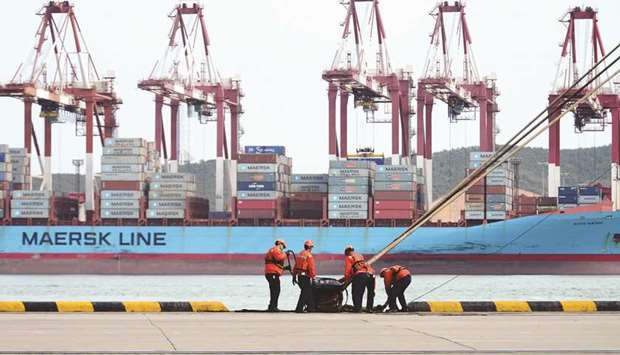
The latest readings on the health of China’s trade sector are unlikely to ease tensions following weeks of tit-for-tat tariff threats by Washington and Beijing, though they suggest China’s economy is still in relatively solid shape.
Even as China’s trade surplus narrowed overall in the first three months of the year, its surplus with the US surged 19.4% to $58.25bn from a year earlier, customs data showed on Friday.
While China was busy selling more to the US, it was buying more from other countries, and ran a $9.86bn deficit with the rest of the world in the quarter.
China’s overall exports and imports both grew at a strong double-digit clip early in the year, and while exports unexpectedly fell in March — resulting in a rare trade deficit — most analysts chalked it up to seasonal factors and said it was too early to call a trend.
Still, while no hard timeline has been set by either Washington or Beijing for the actual imposition of tariffs, analysts said China’s exporters may already be adapting their strategies as punitive trade measures loom.
China’s first-quarter exports to the US rose 14.8% from a year earlier, despite a 5.6% drop in March.
Its imports from the US rose 8.9% in the quarter and 3.2% in March.
That helped narrow its surplus with the US in March alone to $15.43bn from $20.96bn in February, but that was still nearly 18% higher than March 2017.
“The sharp decline in March export growth after very solid performance in January and February suggests some exporters may have front-loaded exports (early) this year due to concern over the possibility of a Sino-US trade war after the US hiked tariffs on global imports on solar panels and washing machines,” said Lisheng Wang, an economist at Nomura in Hong Kong.
“We believe export growth will slow due to yuan appreciation and rising trade tensions...China’s imports could be more resilient than exports in our view as China has pledged to increase imports,” Wang said. China’s total aluminium exports in March rose to their highest since June, just as the United States imposed tariffs on imports of the metal and steel on March 23.
For the first quarter as a whole, China’s exports grew a hearty 14.1% from a year earlier. March shipments fell 2.7%, however, lagging analysts’ forecasts for a 10.0% increase, and down from a sharper-than-expected 44.5% jump in February, which economists believe was heavily distorted by seasonal factors.
“Most of (the March) drop is seasonal — Chinese New Year was later than usual this year, meaning more of the holiday disruptions will have dragged into March than in 2017,” Capital Economics Senior China Economist Julian Evans-Pritchard wrote in a note.
March import growth of 14.4% beat expectations, however, suggesting China’s domestic demand may still be solid enough to cushion the blow from any trade shocks.
Analysts had expected imports to grow 10.0% in March, picking up from 6.3% growth in February.
That produced an unexpected trade deficit of $4.98bn for the month, but such shortfalls are not uncommon for China early in the year, again likely due to holiday distortions.
For Jan-March, imports rose a strong 18.9% on-year. Imports of commodities continued to lead the way in March as manufacturers replenished inventories ahead of a seasonal pick-up in demand. Shipments of copper, crude oil, iron ore and soybeans all rose from the previous month.
Analysts are still expecting China’s economic growth to slow later in the year, however, as a cooling property market weighs on demand for building materials from cement to steel.
China’s exports rode a global trade boom last year, expanding at the fastest pace since 2013 and serving as one of the key drivers behind the economy’s forecast-beating 6.9% expansion. But the sudden spike in trade tensions with the United States is clouding the outlook for both China’s “old economy” heavy industries and “new economy” tech firms alike.Washington says China’s $375bn trade surplus with the United States is unacceptable, and has demanded Beijing reduce it by $100bn immediately.
In a move to further force China to lower the billions of goods trade surplus running with the US, Trump unveiled tariff representing about $50bn of technology, transport and medical products early this month, drawing an immediate threat of retaliatory action from Beijing.
China’s tech sector, which is key part of Beijing’s longer-term “Made in China 2025” strategy to move from cheap goods to higher-value manufacturing, may be particularly vulnerable. Hi-tech products have been among its fastest growing export segments. China exported $137.8bn worth of high-tech products in the first quarter, up 20.5% on-year.