


Shareholders in billionaire Oleg Deripaska’s aluminium group have lost more than half their money exiting positions since the US imposed sanctions last week. They’re the lucky ones.
The company’s bondholders have until May 7 to sell $1.6bn of dollar-denominated securities, but haven’t been able to because the two biggest intermediaries won’t facilitate trades, according to people familiar with the matter. That leaves those creditors of United Company Rusal at risk of having their investments frozen by the US Treasury Department and being forced to write off the debt.
Euroclear and Clearstream are blocking transactions because Rusal’s bonds were issued by a subsidiary that isn’t explicitly authorised by the Treasury’s Office of Foreign Assets Control, said the people, who asked not to be identified because the trades are private. The US extended sanctions on April 6 to include swathes of oligarchs and firms connected to the Russian state, highlighting the extent of geopolitical risks as relations deteriorate.
“It’s the paradox of sanctions: you want to punish Russia, but western creditors are the first to take losses,” said Antonio Agresta, a bond trader at City & Continental in London. “Bondholders want to sell but they’re stuck with the securities.”
Agresta said the situation is evolving and a solution could still be found before the deadline.
Clearstream said in a statement on Tuesday that it won’t facilitate trades in any securities issued by “specially designated nationals” or entities they control, except for certain shares and depository receipts. It’s “investigating” the status of securities issued by subsidiaries.
Euroclear has implemented measures to monitor securities impacted by the sanctions and suspended automated processing of trades, completing manual settlement only after performing due diligence checks, an official said by e-mail on Wednesday, while declining to comment on individual issuers or securities.
“It likely will be possible to sell equities, but exiting debt holdings appears to be more challenging,” said Michael Casey, an attorney at Kirkland & Ellis in London, who has advised clients on the sanctions this week. “The US government increasingly has elected to project power through economic sanctions. This particular round of sanctions illustrates just how powerful they can be.”
Unlike other Russian companies the US has punished in the past, such as Mostotrest PJSC, which is helping build a multibillion-dollar bridge linking Russia’s mainland with annexed Crimea, Rusal is embedded in western capital markets.
Just this year, it sold $500mn of bonds to international investors. Rusal has a total $8.5bn of debt, including the $1.6bn of dollar bonds, according to data compiled by Bloomberg. Those bonds were sold by Rusal Capital DAC, a subsidiary incorporated in Ireland.
“OFAC is going into new territory,” said Adam Smith, a Washington, DC-based sanctions attorney at Gibson Dunn who worked at the Treasury’s office for five years until 2015. “The agency has never blacklisted major public companies that have substantial floats on western exchanges.”
OFAC is the successor organisation to the Office of Foreign Funds Control, established during World War II to prevent foreign-exchange and other assets from occupied countries falling into enemy hands.
The most recent sanctions list cited allegations that Deripaska had bribed a government official and murdered a business rival.
Since the US blacklisted Deripaska and his firm, Hong Kong-listed shares in the largest producer of aluminium outside China have dropped 56% to HK$2.04. The Russian government may support the company with emergency loans after international trading houses stop buying.
Moody’s Investors Service and Fitch Ratings withdrew their ratings of Rusal and notes issued by Rusal Capital DAC this week.
Companies not directly targeted by the Treasury’s sanctions have also been impacted. While US investors are still allowed to own and trade securities of Polyus PJSC, a gold company controlled by the son of another listed oligarch, its $500mn of bonds sold at par in January dropped to about 85 cents on the dollar this week, according to data compiled by Bloomberg.
“It’s going to be very difficult,” said Danforth Newcomb, a sanctions lawyer at Shearman & Sterling in New York. “Still, the mantra of sanctions officials is that the pain on the target is even greater.”
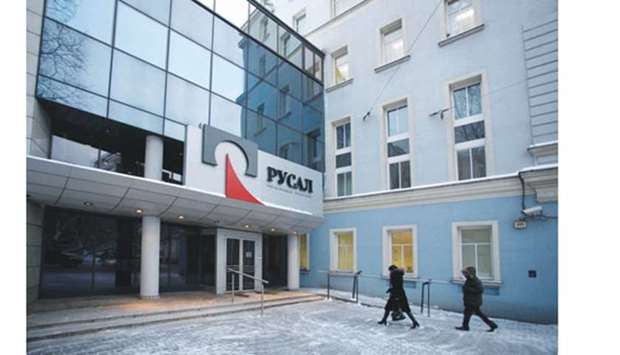
Employees enter the headquarters of United Company Rusal in Moscow (file). Rusal has a total $8.5bn of debt, including the $1.6bn of dollar bonds, according to data compiled by Bloomberg.