


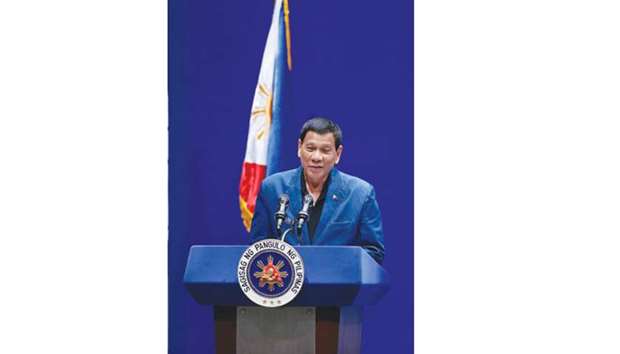
However Duterte yesterday said an apology to “the Chinese government and the people of China” was “only right” and necessary. “From the bottom of my heart as the president of the Republic of the Philippines and in behalf of the people of the Philippines, may I apologise formally to you now,” Duterte said in a speech before the Filipino community in Hong Kong. “We are sorry that the incident happened and as humanly possible, I would like to make this guarantee also that it will never, never happen again.”
Hong Kong had been infuriated by the Philippine government’s response to the incident, in which a disgraced former police officer hijacked a tour bus in protest at his sacking. Day-long negotiations to release the hostages trapped on the bus failed and, with the drama being broadcast live around the world, Philippine security forces bungled a rescue attempt.
A deeply emotional row was resolved in 2014 after the Philippine government expressed “its most sorrowful regret and profound sympathy” but avoided a formal apology. An apology was instead issued by the Manila city government.
Duterte, 73, was elected in mid-2016 and had sought to improve his nation’s relations with Beijing despite a territorial row over the South China Sea as he courted investments and trade from the world’s second-largest economy. He visited Hong Kong after participating in the Boao Forum — dubbed the Asian Davos — in China where he met with President Xi Jinping on Tuesday.
Yesterday’s apology came as Duterte declared the Philippines’ “love” for China. “I hope this would go a long way to really assuage the feeling of the Chinese people and government,” Duterte said. A small anti-Duterte demonstration had been held earlier in Hong Kong, home to around 190,000 Filipina domestic workers.
Around 50 people gathered near his hotel to chant slogans in protest at his war on drugs, which they said was a sham used to target activists and opponents.
Work forces Filipinos to miss meeting with president
Philippines President Rodrigo Duterte had a meeting scheduled with 2,500 overseas Filipinos in Hong Kong yesterday, but most others were unable to attend due to their restrictive and often abusive employment conditions. One Filipino domestic worker in her 50s told DPA she admires Duterte and the many “improvements” she feels he has made to the Philippines since taking office two years ago.
“We would ask to lessen the hours that we are working here, because most of the (overseas foreign workers) here (spend) almost 24 hours a day working,” Emma, who did not wish to be fully identified for fear of professional repercussions, said. With the average Hong Konger working 50 hours a week, the most in the world according to a 2015 UBS survey, the city employs 350,000 domestic staff like Emma to raise children, take care of the home and increasingly to look after elderly family members.
Around half of Hong Kong’s domestic helpers are from the Philippines and almost all are women. The rest come from other Asian countries including Indonesia and Nepal and are required by law to live with their employer, which means the workday can go long past dinner time.
Long hours are exacerbated by prolific physical and verbal abuse, as well as racism against south-east and south Asians. Some workers are thousands of dollars in debt to employment agencies or may fall prey to human traffickers in an attempt to find work overseas.
“We see an average of 1,000 new clients a year, 80% of whom are from the Philippines,” Hong Kong’s HELP for Domestic Workers director Holly Allan said. “A number of them complain of ill treatment and poor working conditions such as excessive working hours and inadequate rest, insufficient food provision, verbal abuse and unsuitable accommodation. There are also cases of physical and sexual assault,” she added.
In one of Hong Kong’s most high-profile cases, Indonesian Erwiana Sulistyaningsih was beaten and burned by her employer for eight months in 2014. The employers were sentenced to six years in prison, yet cases of abuse continue to appear regularly in local media.
President Duterte, who arrived in Hong Kong on Tuesday, has used his foreign trips to rail against the mistreatment of overseas Filipinos.
Hong Kong has so far avoided Duterte’s ire – despite chronic stories of abuse, its situation remains less dramatic than working conditions faced by Filipinos elsewhere in the world. Duterte recently threatened to ban Filipinos from working in Kuwait after the body of a missing domestic worker was found in the freezer of her employer’s old apartment in March.
Thousands of Filipinos continue to be motivated by foreign wages, making it unlikely Duterte can ban workers from every country with cases of abuse while he presides over an economy deeply dependent on its overseas labour force.
In Hong Kong, workers like Emma are paid HK$4,310 (US $549) a month; a small sum by international standards but five times more than in Manila where she would make 5,000 pesos ($96) for the same work.
With married children, Emma saves most of her salary but workers can send up to three-quarters home if they have school-age children.
Protesters gather outside venue in Hong Kong
A small group of about 50 protesters demonstrated outside a speech by Philippine President Rodrigo Duterte in Hong Kong yesterday, local media reported. Duterte is concluding his three-day visit to Hong Kong with a final event for the 2,500 overseas Filipinos in the former British colony. While the president enjoys wide support among the Hong Kong Filipino community, yesterday’s protest drew attention to his controversial human rights record back home. Since taking office two years ago, he initiated a bloody war on drugs that has taken the lives of over 12,000 people according to Human Rights Watch.
“From a populist president, he has become a mass murderer,” Eman Villanueva, spokesman for the lobby group Asian Migrants Co-ordinating Body, was quoted as saying by the South China Morning Post. Hong Kong is home to over 175,000 Filipinos who work in a variety of industries from hospitality to security although the vast majority are employed as domestic workers.