


A team from Qatar University has won the 10th Annual Undergraduate Research Experience Programme (Urep) Competition organised by the Qatar National Research Fund (QNRF), a member of Qatar Foundation (QF).
More than 3,200 students from universities in Qatar have benefited from Urep over its lifespan, participating in 937 projects across 22 cycles. The top 25% of projects completed under the programme in 2017 were selected to participate in the 10th Urep competition, with QNRF announcing the results during a ceremony held at Qatar National Convention Centre recently.
In total, seven projects – covering a range of areas including health; energy and environment; computing and ICT; and social sciences, arts, and humanities – were shortlisted for the competition, with each team giving a public presentation in front of a panel of judges. Four of the shortlisted projects came from QU, two from Texas A&M University at Qatar (Tamuq) and one from Northwestern University in Qatar.
The projects were evaluated for the quality of their scientific and technological content, the degree of research experience that their teams gained, and the quality of their oral presentation to judges. The first place was awarded to ‘Antifungal Activities of Prosopis Juliflora on Postharvest Fungal Pathogens of Fruits in Qatar’, a QU project that investigated the effect of an exotic plant on Qatar’s biodiversity and agriculture.
“Urep has been an incredible experience for us, and to win the competition is both unexpected and amazing,” said team member Nada Kafour, who conducted the winning project with fellow QU students Nada Sadeq, Sabah Akhtar, Sabah Ahmad, Fatemeh Saadat and Widad al-Asmar.
The team was mentored by Dr Mohamed Abu-Dieyah, associate professor, College of Arts and Sciences, QU, who said: “I feel very proud of these students, who have produced such a high standard of impactful research, which, if further developed and enhanced, has the potential for commercial application.”
Teams from Tamuq took the second and third places with projects titled ‘A Novel Experimentation on Demulsifying Crude Oil and Water Emulsions Using Ultrasonic Technology’, and ‘Development of a Novel Heat Sink with Wavy-Tapered Channels’.
Dr Aisha al-Obaidly, director, Capacity Building, QNRF, said: “Research experience can allow students to stand out from the crowd, as graduate schools and the job market within industry become more competitive.”
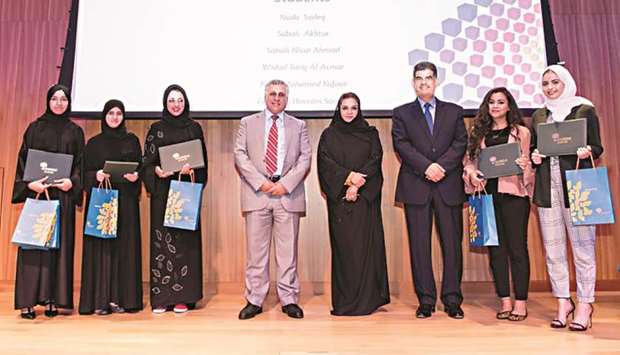
The winners of the competition with QNRF officials.