


European Central Bank President Mario Draghi says progress on euro-area growth and inflation will continue this year even as policy makers struggle to estimate just how much unused capacity remains in the economy.
“Looking ahead, we expect the pace of economic expansion to remain strong in 2018,” Draghi said in the institution’s annual report published yesterday. “While we remain confident that inflation will converge towards our aim over the medium term, there are still uncertainties about the degree of slack in the economy.”
The ECB will therefore maintain a “patient, persistent and prudent” policy stance, he said. The Governing Council is expected to start winding down its asset purchase programme later this year after it decided to reduce the pace of its purchases from January, marking its increased confidence in the economic outlook.
A spate of recent data for the euro area has pointed to growth levelling out, with gauges for economic activity and retail sales missing economist estimates and investor confidence slipping. The downward dynamic has been particularly pronounced in Germany, the region’s largest economy, where figures for exports and industrial production both saw a sharp drop in February.
Economists have so far written off much of the slowdown as being caused by temporary factors. Prior to the release of many of the recent data, the ECB in March raised its 2018 forecast for growth to 2.4%. The Governing Council next meets on April 25-26.
While the central bank is confident in the economic outlook, Draghi said officials have acknowledged that patience is needed for inflationary pressures to build up. Still, the impact of lower unemployment on price pressures isn’t so straightforward, and the annual report cites recent research that shows models measuring this relationship tend to overestimate inflation.
“While traditional models provide a good understanding of the drivers of inflation in the euro area, they do not fully capture the complexity of the current economic environment in generating inflation,” the report stated. “Nevertheless, economic slack is still relevant and, in the euro area, the rebound in economic activity is expected to drive underlying inflation gradually upwards.”
Th ECB also criticised fiscal positions of some members of the euro area, saying several of them were still “sub-optimal.” Policy makers have often stressed that governments should use the window of opportunity provided by the ECB’s still-accommodative policy to improve fiscal positions and implement structural reforms. The report states that the latter tend to occur during an adverse macroeconomic environment, rather than during periods of strength.
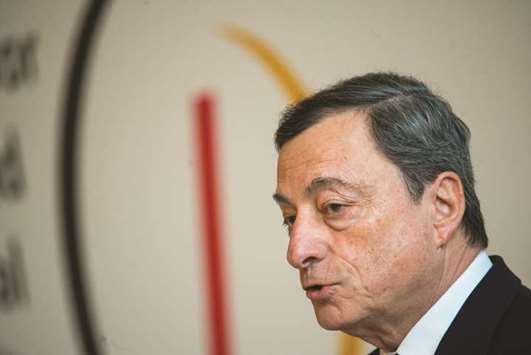
u201cLooking ahead, we expect the pace of economic expansion to remain strong in 2018,u201d Draghi said in a report published yesterday.