


The University of Calgary in Qatar (UCQ) recently held a continuing professional development (CPD) symposium on the topic of immunisation for 60 nurses from Primary Healthcare Centres around the country.
Launched at the invitation of Primary Health Care Corporation (PHCC), the event was the first of an ongoing series of CPD opportunities organised by the university in order to enhance the professional growth of healthcare practitioners in Qatar.
UCQ, which is the exclusive provider of Bachelor and Master nursing programmes in the country, partnered with PHCC and Weill Cornell Medicine – Qatar (WCM-Q) to organise the event. Guest speakers included Dr Amal Khidir of WCM-Q, Dr Khalid El-Awad from the PHCC and Dr Shane Pawluk from the College of Pharmacy, Qatar University.
By the end of the year, 250 primary care nurses from numerous healthcare facilities in Qatar will have participated in this series on vaccination, UCQ has said in a statement.
Topics presented and discussed included the importance of vaccines in preventing illness and disease from spreading, how vaccines activate an immune response, how vaccines are developed and rigorously tested for safety, and the safe storage and handling of vaccines. Qatar’s National Immunisation Guidelines and immunisation schedule, along with strategies for health promotion to improve immunisation rates in Qatar were also carefully reviewed and discussed.
Upcoming CPD in this series will also include practical workshops and clinical simulations to be led by University of Calgary in Qatar faculty members.
“The curriculum we are using was guided by immunisation competencies for healthcare providers developed by the Canadian Public Health Agency. These were then adapted to meet the standards of the Qatar National Immunisation Guidelines for vaccine providers, released in 2017,” explained Dr Deborah White, dean, UCQ. “This subject is very important because we need to make sure vaccine providers receive ongoing competency education. It’s a public health responsibility to ensure that healthcare providers are trained how to give vaccines and that they provide appropriate and timely information to the public. Our faculty are very excited to be engaged in this event and to be make such an important contribution to the community.”
Dr Zelaikha Mohsin al-Wahedi, executive director for Workforce Development and Training in PHCC, is a firm advocate of professional development and continuous healthcare improvement.
“PHCC is leading on a five-year nursing visionary strategic plan aligned to the national initiatives, which highlights our commitment to the development of all our nurses to provide the highest quality of patient care and experience in primary healthcare,” explained Dr al-Wahedi. “The nursing vaccination programme is an exemplary example of this commitment, working closely with our universities, to design and deliver an enriched competency based education programme. This will enable continuous professional development for all our nurses, as part of healthcare teams, to improve clinical outcomes and satisfaction for all our patients.”
Dr Amal Khidir, associate professor of paediatrics at WCM-Q, gave a presentation about basic immunology and vaccine-preventable diseases.
Dr Khidir said, “Qatar is blessed with a very diverse multicultural context of health providers, patients and its population in general. This diversity brings with it many competencies but also leads to complexity and variability in the approach to immunisation and the advice shared with patients. For this reason it is great to work alongside other health professionals to unify and standardise immunisation-related practices. These modules are very hands-on and they address knowledge, skills and attitudes towards immunisation, making them both effective and practical. I am honoured to be part of this team.”
In 2017, UCQ received its official accreditation as a continuing professional development provider from the Qatar Council for Healthcare Practitioners under the Ministry of Public Health. This accreditation certifies the university to provide this education.
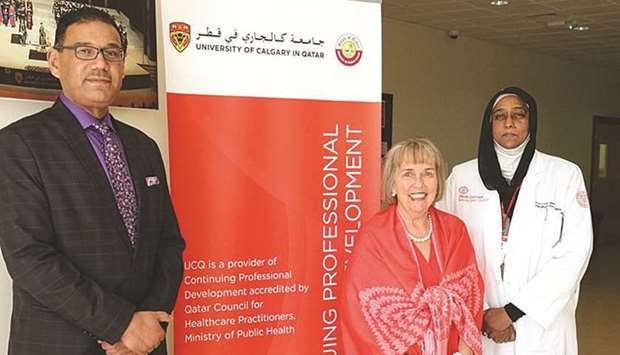
Dr Deborah White welcomes Dr Amal Khidir and Dr Khalid El-Awad.