


Half of the planet cannot access essential health services. For many
people, paying to see a doctor, obtaining medications, seeking
family-planning advice, or even getting immunised against common
illnesses is a choice between staying healthy and slipping into poverty.
And, more than ever, the healthcare options that poor people do have
are being degraded by a familiar foe.
In many low- and middle-income countries, corruption, inadequate
spending, and wasted resources pose enduring challenges for healthcare
systems. Growing up in Pakistan, I saw people forced to go to extremes
to secure healthcare. For example, families might be forced to sell off
cattle and other valuables to pay exorbitant medical bills.
What is shocking is that the scourge of health-related poverty continues
to claim victims today. Indeed, in some countries, people falling into
poverty due to the high cost of healthcare is an everyday reality.
On a recent trip to Africa, I heard a harrowing story of a hospital
where women and their newborns are routinely held hostage – often for
months – until families can find the money to settle their bills.
According to researchers at the University of California, San Diego,
corruption, waste, and unethical billing cost patients and health
systems billions of dollars annually. In the United States, as much as
10% of public-sector spending on healthcare is lost to fraudulent
billing, and tens of millions face significant economic barriers to
healthcare.
Clearly, improving health outcomes requires both increased government
spending and an end to shady practices that siphon crucial resources
from the health system. But how?
Around the world, corruption and collusion are institutionalised in many
healthcare systems. Of the $6.5tn spent annually on healthcare, an
estimated $455bn is lost, misused, or stolen. Simply put, health costs
are bankrupting some of the poorest people in the world, because many of
the richest are lining their pockets.
There is growing consensus that affordable, quality healthcare is a
basic human right. The United Nations Sustainable Development Goals
include universal health coverage as a target. And it is not only rich
countries that have embraced this goal: from Thailand to Costa Rica to
Rwanda, countries with mixed health systems and limited resources have
dedicated funds and political capital to making universal healthcare a
reality.
Steps are being taken to help these countries succeed. Last year, Japan
pledged $2.9bn to help developing countries achieve universal health
coverage. And the World Bank has indicated that a country’s ability to
borrow from it could eventually be tied to investments in human capital,
including health spending.
But such gestures, however laudable – and overdue – will not be enough
to remove the barriers to quality health services. Until corruption,
theft, and wasteful and inefficient spending are addressed more
vigorously, universal health coverage will remain aspirational.
Fortunately, governments are increasingly committed to solving the
corruption crisis. Tax evasion and fraud – both common crimes – are
drawing closer scrutiny from law enforcement agencies. Tax evasion
doesn’t just enable money laundering; it also robs the public sector of
important resources. This is one reason why the UN has made reducing
illicit financial flows a key component of achieving the Sustainable
Development Goals.
With broad agreement on the need to combat corruption in the health
sector, the harder challenge will be developing workable remedies.
National treasuries, finance ministries, and anti-corruption agencies
need to strengthen their efforts to co-operate on prevention, detection,
and enforcement. Improving transparency in financial systems could also
help curb corruption, while civil-society groups, journalists, and
patients should push for greater accountability from governments and
medical providers.
In the future, new technologies like data mining, artificial
intelligence, and blockchain could offer new ways to detect wrongdoing
in the health sector; these and other tools should be investigated
fully.
Expanding healthcare access and protecting the sector’s finances are
dual challenges that the international community must address together.
There is an urgent need to act without delay. Rates of noncommunicable
diseases like cancer, diabetes, and cardiovascular disease are
increasing almost exponentially, and lack of access to quality care will
add to many countries’ governance challenges.
Development strategists understand that poor health is a harbinger of
poverty and a barrier to eliminating it. Today, some 800mn people spend
at least 10% of their household budgets on health, often going into debt
to fund the treatment they need. The fact that so many people cannot
afford to visit a doctor is truly shameful. The world needs universal
health coverage; but to achieve it, the world’s health sector must
undergo treatment of its own. – Project Syndicate
* Sania Nishtar is a co-chair of the World Health Organisation’s
Independent High-level Commission on Noncommunicable Diseases, a former
federal minister of Pakistan, and the founder and president of
Heartfile. Find her on Twitter at @SaniaNishtar.
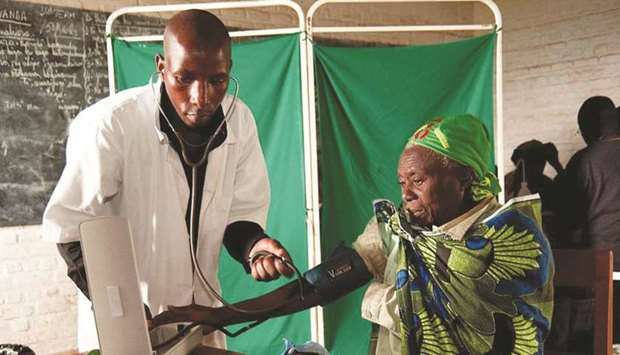
A Mobile Health Care Clinic in Rwanda. The world needs universal health coverage; but to achieve it, the world’s health sector must undergo treatment of its own.