
The tax amnesty scheme is expected to augur well with the stock market, which has been rallying for the last one week ahead of its announcement, as it might stimulate foreign inflows into the capital market, a brokerage said yesterday.
“The scheme will be reflective of the government’s efforts to address the external account woes, which will resultantly attract foreign flows into the country,” Faizan Kamran, an analyst at Arif Habib Limited said in a report.
Pakistan Stock Exchange’s benchmark KSE-100 shares index gained 3.45% in the last seven consecutive days ahead of the tax amnesty scheme which was announced yesterday to authorise Pakistanis to pay a flat 2% to 5% tax to bring their foreign assets back to the country.
The scheme’s beneficiaries will also get immunity from different other laws, including National Accountability Ordinance 1999, Income Tax Ordinance 2001, Companies Act 2017, Foreign Exchange Regulations Act 1947, Prohibition of Benami Transactions Act 2017 and Federal Investigation Agency Act 1974.
Chairman Arif Habib of Arif Habib Group said the economic fundamentals are improving and corporate sector is growing.
“Only the current account deficit is a cause of worry and that too could be addressed through the amnesty scheme and increased exports,” Habib said last week.
“The market would welcome the tax amnesty scheme.” Around $93.5mn flew from the capital market on account of portfolio investment in equity securities during the first eight months of the current fiscal year of 2018, although it was down from $351.9mn in the same period a year earlier, according to the central bank.
Kamran said chances of success of the amnesty scheme as opposed to previous ones are higher as globally regulations pertaining to ‘anti-money laundering’ and ‘know your customer’ have become much more stringent and list of immunity from different ordinances is larger in the scheme. “Previously immunity was only restricted to a few ordinances,” he added.
Immediate outcomes of the amnesty scheme would be widening of the tax revenue base and broadening of current account deficit. In February, current account deficit narrowed a 25.5% to $1.2bn as compared to the preceding month, the State Bank of Pakistan said.
The current account deficit, however, jumped 50% to $10.8bn during the first eight months of the current fiscal year of 2018. Current account deficit currently amounts to 5% of GDP. “As long as the country can continue to find sustainable means of financing its current account deficit, the prevailing scenario should not pose serious threats to the sustainability of the economy going forward,” Kamran added.
Recent currency depreciation should support the balance of payment by fuelling exports and discouraging imports.
Business / Eco./Bus. News
Tax amnesty expected to trigger foreign inflows to Pakistan Stock Exchange


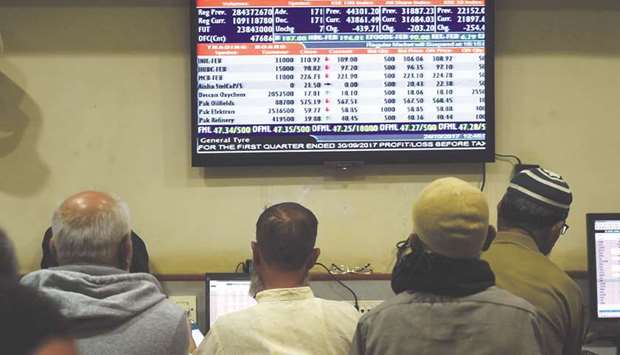
Pakistan stockbrokers look at share prices on their computer monitors during a trading session at the Pakistan Stock Exchange in Karachi. The benchmark KSE-100 shares index gained 3.45% in the last seven consecutive days ahead of the tax amnesty scheme which was announced yesterday to authorise Pakistanis to pay a flat 2% to 5% tax to bring their foreign assets back to the country.