


The visit of His Highness the Emir Sheikh Tamim bin Hamad al-Thani to the US, which began yesterday, is new stop on the road of the two countries’ strategic co-operation, and of strengthening the links between them according to a shared vision to serve their common interests, and it contributes to the regional stability and security and global peace.
The visit comes at an invitation that the Emir received via a telephone call from US President Donald Trump in February, during which they reviewed the strategic relations between the two friendly countries and means of consolidating them to serve their common interests.
Although the areas of co-operation between the Qatari and US sides cover many economic, military, security, cultural and other sectors, the visit is an appropriate opportunity to review what has been achieved in this regard during the last period, and what the officials of the two countries aspire to, in terms of opening new horizons for co-operation and strategic partnerships between the two countries, thus providing more fruitful opportunities and mutual benefits for them especially in the economic, investment and military sectors.
The Emir’s visit to the US comes at a time when Qatar has succeeded in addressing the unjust siege imposed on it, as well as in breaking and defeating the siege, in light of the support of the international community for the Qatari position, which insists on resolving the Gulf crisis through dialogue and peaceful means, far from conditions and dictates. The siege countries have failed to provide any evidence of their accusations against Qatar on supporting terrorism because such evidence does not exist at all, not to mention that Qatar is the first country to sign a memorandum of understanding with the United States to combat the financing of terrorism.
His Highness the Emir’s visit also comes amid reports that the US-Gulf summit at Camp David which had been scheduled for May will be postponed to September.
Qatar, represented by the Emir, goes to Washington with firm and clear positions, open heart for dialogue and understanding and an extended hand for peace and co-operation on bases mutual respect, non-interference in the internal affairs of others and common interests consistent with the principles of international law.
There is no doubt that the issues of the Arab region, especially the Palestinian cause, the Syrian crisis and the situation in Yemen will be part of the agenda that will be discussed during the Emir’s talks in the United States.
It is certain that maintaining regional and international peace and security is a priority in the foreign policy of Qatar, which is based on the principles and objectives to the Charter of the United Nations and the rules of international legality that call for constructive co-operation among states, mutual respect, non-interference in internal affairs, good-neighbourliness, promoting peaceful coexistence and peaceful means of settling disputes.
The Qatari diplomacy and its various initiatives have earned the respect and appreciation of the American side and many other countries and international organisations and institutions, as Doha plays a prominent role in mediation initiatives, conflict resolution efforts, attempts to reconcile conflicting parties and help formulate solutions and political agreements for crises.
The Qatari-US ties date back to 1972 after the establishment of diplomatic relations between the two countries following the independence of Qatar, but have significantly developed since the 1990s under strategic partnerships in the economic, investment, military and cultural fields.
Qatar has had excellent relations with various US administrations through mutual visits and at the highest levels.
His Highness the Emir visited Washington in February 2015 and met President Donald Trump in New York on September 19, 2017. During the meeting, they discussed regional and international issues, particularly the Gulf crisis and the efforts exerted to resolve it through dialogue and diplomatic channels.
On January 30, the governments of the two countries held their first strategic dialogue in Washington, DC, which marked a milestone in the bilateral relations as well as the course of developments in the region, especially as it resulted in increased consensus and convergence in the strategic visions between the two countries and reiterated the need for them to remain allies and close friends.
It also marked the beginning of a strategic partnership between Qatar and the US, and was culminated in the signing of memorandums of understanding and security co-operation agreements that have broadened the relations to new horizons covering various fields in an unprecedented manner.
Within the framework of the strategic dialogue, the two governments issued a joint statement on security co-operation, reaffirming their commitment to promoting peace and stability and combating the scourge of terrorism.
The United States expressed its willingness to work jointly with Qatar, in accordance with the provisions of the UN Charter, to deter and counter external threats to the territorial integrity of the Qatari soil.
This strategic dialogue underscored that the link between Qatar and the US is a strategic partnership that Washington has not held with any Arab country, a partnership that includes politics, economy, investment, as well as security, military and defence co-operation.
The dialogue also shows that Qatar and the US plan to strengthen military relations within the framework of the 2040 Vision, which include hosting the US Navy and strengthening the Al Udeid Base to become a strategic base in the region.
Qatar and the US discussed the Gulf crisis and underscored the need for an immediate solution in a way that respects Qatar’s sovereignty.
The two governments expressed concern about the damaging security, economic and humanitarian impact of the crisis and expressed concern about peace and stability in the Gulf and about adherence to international law.
Qatar appreciated the role played by the United States in mediating the conflict in support of the efforts of the Emir of Kuwait, Sheikh Sabah al-Ahmad al-Jaber al-Sabah.
The joint statement pointed that the two governments intend to define and prioritise co-operation in various fields on basis of the results of the first dialogue and decided to establish a working group to develop the common policy priorities and political partnerships.
On the economic level, the US is the sixth largest trading partner of the State of Qatar as the volume of trade between the two countries reached about $6bn in 2016, in addition to the presence of more than 120 US companies operating in Qatar, especially in the field of energy.
Qatar has also announced a plan to invest $45bn in the United States.
Moreover, in June 2017 the two sides signed a military agreement to purchase F-15 fighter jets, at an initial cost of $12bn.
Qatar and the US have succeeded to establish a strong link in education and culture, as six US universities have opened branches in Education City in Doha, including Virginia Commonwealth University, Weill Cornell Medical College, Texas A & M University, Carnegie Mellon University, Georgetown University and Northwestern University.
In addition to the student exchanges between the United States and Qatar, there are hundreds of Qatari students, including scholarship students, studying in the United States.
The visit of the Emir to the US is very important by all local, Arab and international standards.
It will constitute a new shift in relations of co-operation and coordination with the United States.
The outcomes of the visit will have positive repercussions for the consolidation of bilateral relations with the American side in various fields, for Qatari government and people, for the peoples of the region and for international security and stability.
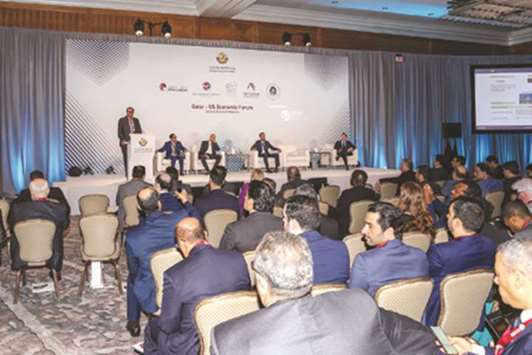
Qatar-US Economic Forum session in Miami on Thursday.