


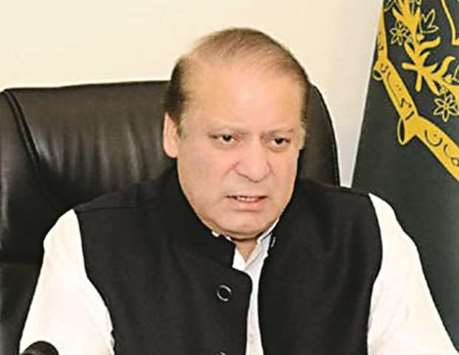
The Pakistan’s federal government has decided not to contest the Supreme Court’s judgment on The Elections Act, which disqualified former prime minister Nawaz Sharif from being head of the Pakistan Muslim League - Nawaz (PML-N).
The federal government on March 22 filed a review petition through Additional Attorney General Waqar Rana, requesting the SC to set aside its February 21 judgment.
However, it was returned due to incomplete legal requirements on the same day. However, the SC registrar had given the federal government two weeks to file a modified review petition.
Sources said that the attorney general for Pakistan’s (AGP) office has given its legal advice to the federal government and suggested that a review petition not be filed as the government is not an aggrieved party.
“The AGP office advised that as the SC did not strike down certain provisions of the Election Act, the federal government lacks locus standi to file a review petition,” they added.
The government is expected to accept the advice and not challenge the SC’s verdict. The PML-N never filed a review petition against the verdict, meaning that the judgment on the disqualification of Sharif is essentially final.
A senior PML-N lawyer informed that though the party’s counsel Salman Akram Raja advised challenging the SC’s judgment, one section of the ruling party has shown complete mistrust in the bench which heard petitions against The Elections Act.
“The superior judiciary should itself consider why a major political force (PML-N) lacks trust in the top court,” he further stated.
The PML-N lawyer believes that at this time, it is unlikely that the PML-N will get relief in any matter.
However, he said, this is a classic case for review as the SC deviated from its own principles set in Benazir Bhutto’s case in 1988. The lawyer also raised questions over the SC’s detailed judgment in the case, wherein it gave a nexus between Islamic morality
and political party head.
Pakistan People’s Party (PPP), Pakistan Tehreek-e-Insaf (PTI), and others had approached the Supreme Court to seek the disqualification of Sharif as party chief after the Panama verdict of July 28, 2017, wherein he was declared ineligible to hold public office under Article 62(1)(f) of the constitution.
The court started hearing the Elections Act case on January 1.
Farogh Nasim, Sardar Latif Khosa, Babar Awan and others argued on behalf of the petitioners, while Salman Akram Raja contested the case for the PML-N.
Additional Attorney General Rana also argued the case. Though Sharif was also party to the case, he did not engage any counsel to represent him in the matter.
The three-judge bench, headed by Chief Justice Mian Saqib Nisar, held that morality is part and parcel of the Islamic ideology of Pakistan and is included in the expression, “integrity of Pakistan”
Once again, the Judicial Commission’s (JC) meeting to consider the elevation of Sindh High Court Justice Muneeb Akhtar has been extended from April 9 to April 16, sources revealed. This is the second time the commission meeting has been extended. It was initially fixed for April 5.
One seat in the apex court fell vacant after the retirement of Justice Dost Muhammad Khan earlier this week. If Justice Akhtar is elevated to the apex court, he will be in line to become the chief justice after the retirement of Justice Mansoor Ali Shah in 2027. Justice Akhtar is fourth on the seniority list of Sindh High Court (SHC) judges.
The sources said that according to the agenda of the JC meeting, shared with the concerned members, it was mentioned that before initiating the name of Justice Akhtar, Chief Justice Nisar had contacted three senior SHC judges, namely Justice Ahmed Ali Sheikh, Justice Irfan Saadat Khan and Justice Aqeel Ahmed Abbasi.
“According to the agenda of the meeting, the three judges expressed a desire to continue work at the SHC. After consultation with these judges, the CJ has recommended the name of Justice Akhtar for elevation,” the sources added.
Nawaz Sharif