


Hundreds of internally displaced people (IDPs) from Marawi City were given at least nine hours to inspect their houses and retrieve useful belongings left during the Maute siege in May.
The activity was called “Kambisita,” meaning visitation in the Maranao dialect.
They were allowed to enter the war-torn areas through designated entry and exit routes closely watched by the Armed Forces of the Philippines (AFP) and the Philippine National Police (PNP).
Army Col. Romeo Brawner Jr, deputy commander of the Army’s First Infantry Division (1ID) and Joint Task Force Ranao (JTFR), said this was done to ensure the IDPs safety adding that they were not allowed to freely roam as there were still uncollected roadside bombs and booby traps left by the Maute group.
Different groups of IDPs in batches will also be allowed to visit other areas in the city from April 3 to 30, according to local officials.
Army officials in Marawi City said a comprehensive rehabilitation and reconstruction plan will be presented to IDPs within the month, as a prelude to the start of the government’s rebuilding of Marawi City in May this year.
On Monday, the IDPs belonging to Sector 1 of the Most Affected Area (MAA) were allowed to search and inspect their demolished houses.
The day coincided with the visit of nine ambassadors from various countries including Singapore, India and Russia who brought food supplies for the IDPs.
“The MAA was divided into nine sectors. So far only the first sector has been allowed for identified IDPs to visit. The schedule for Sector 2 is on April 5, 6, and 7,” Brawner said.
He added that the sectors open to the IDPs for inspection were safe and have been cleared of potentially explosive material debris. The other sectors are still in the process of being cleared.
“From May 2017 to February 2018 more than 2,800 pieces of unexploded ordnance have been found during the clearing operations,” Brawner said.
The recovered unexploded ordnance includes a wide range of explosive arsenal like the 500-pound bombs dropped from the air during the war and improvised explosive devices (IEDs) that retreating IS elements left behind.
Brawner said there could still be some unexploded bomb material embedded underneath the ground of some houses in a number of sectors. IDPs who found their homes were in tears when they entered the ruined place with shattered window panes, ransacked refrigerators, wrecked doors and bedrooms, and stolen personal belongings.
A few were able to salvage what is left inside their houses like plastic chairs, tables, and kitchen utensils. “We still consider this our home,” said one elderly IDP. A Marawi-based NGO, the Maranaw People’s Development Centre (Maradeca), assisted the IDPs in searching for their houses and provided refreshments at the war zone.
Meanwhile, Russian Federation ambassador Igor Anatolyevich Khovaev said the Russian government would be willing to assist Marawi in its recovery efforts. It recently shipped about 496 tonnes of food supplies to Iligan for distribution to Marawi IDPs. Brawner said JTFR is looking at the possibility of intelligence information sharing between the Philippines and Russia to fight terrorism in Mindanao.
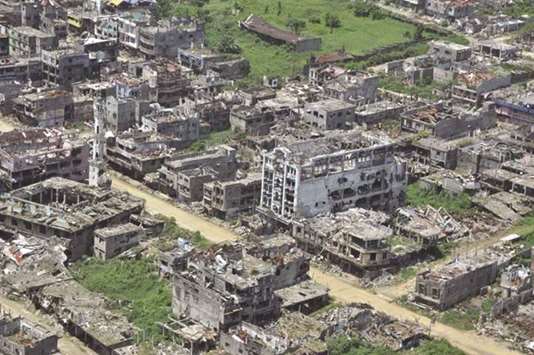
A recent photo shows an aerial shot of bombed-out houses in Marawi City, in southern island of Mindanao, after five months of house-to-house fighting between troops and militants loyal to the Islamic State group that killed nearly 1,200.