


Efrain Rios Montt, a former military dictator who ruled Guatemala between 1982 and 1983 and who was facing retrial on genocide charges, died yesterday aged 91, sources close to his family said.
One of his lawyers, Luis Rosales, told reporters that Rios Montt “died in his home, with the love of his family and a clear conscience.”
Montt is accused of being responsible for the murders of 1,771 indigenous Ixil-Maya people during his short reign, which came at the height of a brutal 36-year civil war.
A May 2013 trial delivered a conviction and an 80-year sentence against Rios Montt — the first time a Latin American ex-dictator had been convicted of genocide.
But that verdict was overturned just days later by Guatemala’s constitutional court because of a “procedural error,” and a new trial was ordered.
That trial of Montt and his spy chief, Jose Rodriguez, was halted in 2016 after an appeals court ruled each man should be tried separately.
Montt’s lawyers sought to block further proceedings against their client, arguing his health was too poor and he suffered from dementia.
According to the UN, some 200,000 people died or were made to disappear during the Guatemala’s long, brutal civil war, which ended in 1996.
Montt was accused of orchestrating an extermination policy against the indigenous population, which was perceived to be collaborating with leftwing guerrillas waging war against government forces.
He denied the charges in his original trial. “I never authorised, never signed, never ordered an attack against a race, an ethnicity or a religion. I never did it!” he said at the time.
Short in stature and vigorous into old age, the former dictator had a humble beginning, with little to suggest a rise to national power.
He was born in Guatemala’s remote Huehuetenango province, near the border with Mexico. He enlisted in the army as a teenager and rose through the ranks, receiving training courses at the US-run School of the Americas, where Latin American officers learned harsh tactics used in crack downs on dissidents.
Politically, Montt came to the forefront in 1974 when, as a brigadier general, he was put forward as a coalition presidential candidate.
Historians say he won an overwhelming victory, but electoral fraud prevented him from taking office. Another general, Kjell Eugenio Laugerud, took power instead.
As a consolation prize, Montt was sent to Spain as the military attache.
Upon returning home three years later, he turned away from Catholicism, his religion of birth, and became a fervent evangelical Christian. On March 23, 1982, he took power in a bloodless coup, deposing Lucas Garcia.
During his 18-month rule, ruthless even by the standards of Latin American dictators, Montt engaged in a “scorched earth” policy against dissidents, wiping out entire rural towns where leftists were suspected of living or having support.
He appointed so-called faceless judges who mounted summary trials and ordered numerous alleged criminals — often leftist rebel sympathisers or militants — executed.
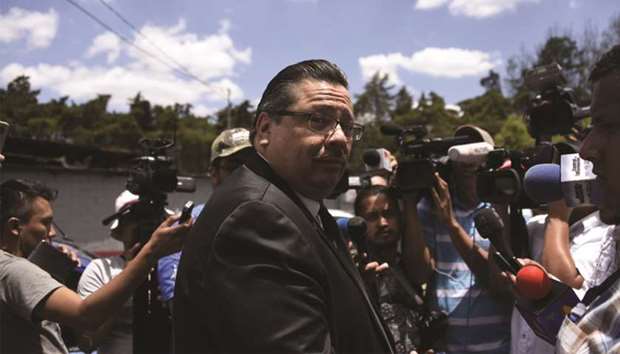
Luis Rosales, lawyer of former Guatemalan dictator general Jose Efrain Rios Montt speaks to the press outside the former dictator’s residence in Guatemala City yesterday moments after his death was announced.