


India plans to split its flag carrier in a bid to entice investors to buy the loss-making airline that has a debt burden of more than $7bn.
India’s administration led by Prime Minister Narendra Modi agreed to sell 76% of Air India Ltd, according to a government statement yesterday.
The budget carrier of the airline will be completely sold, while the state will offer half of the ground handling unit separately, according to the statement.
A successful sale of Air India, which is surviving on taxpayer-funded bailouts, has five subsidiaries and a joint venture, and a combined workforce of as many as 27,000 – is crucial for Modi, who wants to showcase his credentials as a reformist attempting to steer the state away from running businesses.
The funds saved can help the government bolster its finances and boost spending on health and education.
IndiGo, India’s biggest airline, is the only company to publicly disclose a desire to buy Air India’s airline operations – the most lucrative business that includes prime time slots at airports from New York to Heathrow, as well as bilateral rights to start flights to most countries.
Singapore Airlines Ltd and India’s Tata Group, which run a joint venture airline named Vistara in India, said they were also open to look at the sale, but haven’t elaborated yet.
Selling a majority stake in the loss-making, 85-year-old company isn’t going to be a cakewalk.
At least one attempt almost two decades ago failed amid fierce political opposition.
Air India has been unprofitable since its 2007 merger with state-owned domestic operator Indian Airlines Ltd. The company made an operating profit of about Rs3bn ($46mn) in the year through March 2017, primarily due to a slump in oil prices.
It still posted a net loss of Rs57.7bn, junior aviation minister Jayant Sinha told lawmakers on February 8.
Indian regulations allow a foreign airline to buy as much as 49% of a local carrier, while overseas investors other than airlines can buy an entire carrier.
Modi in January tweaked rules in January to include Air India which wasn’t a part of those rules until then.
Air India started as Tata Airlines in 1932 and later became state-owned.
Founded by Jehangir Ratanji Dadabhoy Tata, it took off flying mail between Karachi in then-undivided, British-ruled India and Mumbai.
Once it turned commercial, the airline quickly became popular with its advertisements featuring Bollywood actresses, high-end champagne and surrealist painter Salvador Dali-designed porcelain ashtrays.
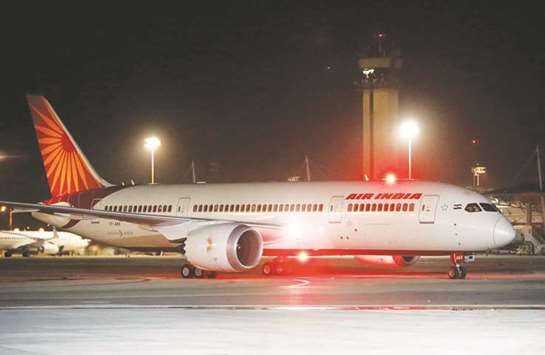
An Air India Boeing 787-8 Dreamliner plane lands at the Ben Gurion International airport in Tel Aviv, Israel. The airline has been unprofitable since its 2007 merger with India’s state-owned domestic operator Indian Airlines.