


The UK’s economic outlook suggests a need for “one or two” Bank of England interest-rate increases per year, according to Monetary Policy Committee member Gertjan Vlieghe.
In a speech in Birmingham on Friday, he said the impact of stronger global growth on the one side, and the damping effect of Brexit uncertainty on the other, is now more balanced.
Meanwhile, record-low unemployment is generating more pressure on domestically generated inflation, increasing the need to remove stimulus, he said.
The BoE, which hiked interest rates for the first time in a decade in November, is widely expected to act again in May. The bank’s measure of the market implied-path of rates shows expectations for three full quarter-point increases over its three-year forecast horizon, which would be the lower bound of the outlook for rate increases Vlieghe sees.
“Provided the balance between global tailwinds and Brexit headwinds remains where it is now, supporting UK growth at or above potential, and provided evidence continues to accumulate that a tight labour market is actually pushing up domestic inflationary pressures, I expect that bank rate will need to rise further over the forecast period,” Vlieghe said. “The current central outlook is, in my view, consistent with one or two quarter-point rate increases per year over the forecast period.”
Raising at that pace would return the key rate to close to the neutral policy rate, which is probably “well below” the pre-crisis level, he said. The BoE has said since last year that any rate increases would be limited and gradual.
The pound rose and gilts fell after the speech. “Being open about the number of hikes he expects per year is the first clear indication of what the MPC means by ‘limited and gradual,”’ said Dan Hanson at Bloomberg Economics.
“Given the recent signals from the labour market we suspect two per year is more likely than one.”
The BoE left its benchmark rate unchanged at 0.5% on Thursday, and didn’t say anything to derail investor bets that a hike will come in May. Markets are currently pricing in around an 85% chance of a move that month, and assign more than a 55% chance of a follow-up in November. Vlieghe added that there is “significant uncertainty about the path of rates, and both lower and higher paths are possible, depending on how the economy evolves,” and that a different path “should not be seen as a mistake, or a breaking of an earlier promise.”
The BoE has expressed concerned that the speed-limit of the economy has fallen since the vote to leave the European Union, leaving it at risk of overheating.
On Thursday, the MPC also noted Brexit developments remain the greatest influence and source of uncertainty over the economic outlook, even after negotiators this week reached an agreement for a 21-month transition period that will start when Britain formally leaves the bloc in March next year.
Still, in his speech on Friday, Vlieghe said that it isn’t necessary for “Brexit headwinds to disappear in short order” for “demand growth to continue at its recent pace.”
“It is sufficient that the balance between Brexit headwinds and global tailwinds remains close to where it is now,” he said.
BoE experiments with anonymous applications
Bloomberg/London
The Bank of England is piloting anonymous job applications to promote diversity.
The more than three-century-old central bank only appointed its first female senior official in 1988, according to a speech by chief operating officer Joanna Place at an event in London on Thursday. It’s one of a handful of new measures to boost the proportion of women at that level to 35% by 2020, from 30% currently, and reduce a 21% median gender-pay gap.
Recruiters at the BoE are looking to mitigate any unconscious bias in the hiring process with the new trial, which will remove all personal information — such as age and interests — from applications but leave some job history and education details.
The trial comes after Transport for London announced it was introducing similar steps to help eradicate its own gender pay gap. This year around 9,000 UK firms and organisations are, for the first time, legally required to report the difference in average pay between their male and female workers.
Place also said that the BoE will unveil a new programme next month to encourage the return of any professionals who have been out of work for a period of time. It will offer a paid six-month placement starting in September with the possibility of a full-time role afterward.
Despite a female resignation rate that is lower than that for male workers, according to Place, the BoE has seen the exit of some of its highest profile women in recent years. Kristin Forbes, Minouche Shafik and Charlotte Hogg all left the rate-setting committee in 2017, while Clara Furse stepped down from the Financial Policy Committee the previous year.
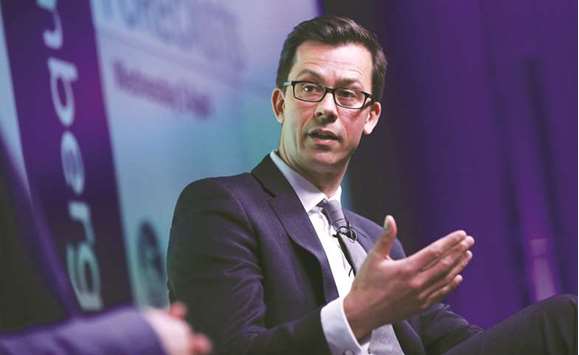
BoE policymaker Gertjan Vlieghe gestures during a speech at Bloomberg’s European headquarters in London. In a speech in Birmingham on Friday, he said the impact of stronger global growth on the one side, and the damping effect of Brexit uncertainty on the other, is now more balanced.