DPA/Washington
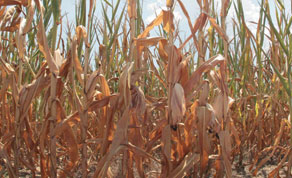
John Hawkins sees nothing but brown and grey when he looks at his maize fields.
“Normally my corn has this deep green colour,” the 57-year-old farmer says.
Near Buffalo, Illinois, about 300km south of Chicago, Hawkins farms 250 hectares, rotating about half in maize and half in soya, the twin row crops that dominate agriculture across the vast Midwestern heartland.
As in much of the region, Hawkins’ fields have felt little or no rain for more than two months. The dry leaves of his maize plants are curling up, as if in defeat.
“You can see it’s struggling,” Hawkins says. “It’s a great ordeal for every farmer to see a crop die.”
About two thirds of the entire country is suffering through the widest drought of the last 25 years. Among the hardest-hit states are Illinois, Indiana, Nebraska, Minnesota and Iowa - the heart of the “Corn belt” and a vital source of livestock feed, ingredients for the food sector and sugars for the burgeoning ethanol fuel industry.
As conditions have deteriorated over the summer, prices have soared: nearly 40% for maize and 25% for soybeans.
“It doesn’t necessarily translate into large increases for food prices,” US Agriculture Secretary Tom Vilsack said at a White House briefing.
The impact on supermarket prices is expected to be modest and felt only late in the year.
Farmers unable to grow pasture grass and confronting mounting feed costs will make the business decision to cut their losses, sending economically unviable livestock to early slaughter and driving down retail meat prices, but leaving smaller herds and leading to a spike in meat prices months later.
On top of the drought, much of the country is sweating through record-breaking heat. July is already well on pace to be one of the hottest months in US history. At least 30 people have died from extreme temperatures often jumping above 40C.
In some places streets buckled; a plane at a Washington airport got stuck on the runway on melted asphalt. City governments have opened up public buildings as daytime cooling centres for people without access to air conditioning.
“On many days it has been above 37 degrees,” says Wayne Blunier, a farmer in Woodford County, Illinois. “The last time we had a real rain was May 4.”
Many of his maize fields are so damaged by drought and heat as to be, in effect, burned. The 71-year-old estimates that his harvest will yield only one-fourth of a normal year’s corn crop.
Woodford, 190km south-west of Chicago, is one of nearly 1,300 counties that have been declared disaster areas by the US Agriculture Department.
“Even if it rains now, it’s not going to green up again,” Blunier says.
Forecasts in Illinois for the rest of July promise little more than tantalising, frustratingly spotty showers - if anything at all.
“Me and my neighbours, we all have been working very hard, just as any other year. You always try to yield the best crop possible,” Blunier says.
Sometimes, in farming, it’s just a bad year, he adds: “As farmers we accept that.”