


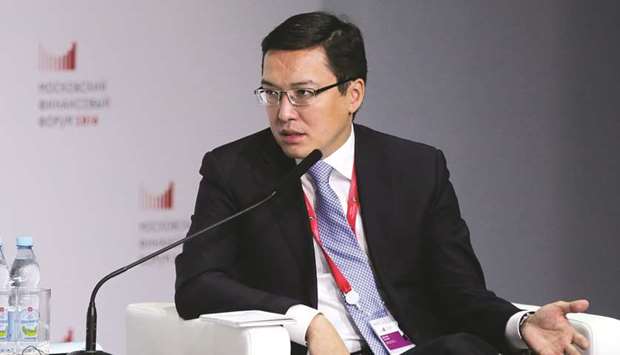
Governor Daniyar Akishev said in an interview that the National Bank of Kazakhstan has just increased its yuan holdings by a third at the start of 2018. Although he didn’t say how much the central bank currently holds, the yuan’s allocation in its $31.4bn reserves remains “small” for now.
“After Xi Jinping’s speech, we see rather sensible things in Chinese policy when it comes to their economy over the next 10 years, so here the prospects are good,” Akishev said in Almaty. “We’ll see how we’ll act in the future. We are getting a feel for the market.”
The former Soviet republic of over 18mn people, which borders Russia and China, has made prescient calls before, exiting its investment in the pound before Britain’s surprise vote to leave the European Union two years ago. Akishev said the yuan is an “interesting currency” that allows Kazakhstan to stay in tune with the economy of its second-largest trade partner. China is estimated to have contributed more than a third of global growth last year, according to the International Monetary Fund.
It’s a view gaining traction among policy makers.
The Bundesbank decided last year to include the yuan in its own reserves, following an investment by the European Central Bank, of which the German authority is a part. Still, with capital controls still in place, the currency backed by the world’s second-largest economy has dropped to the sixth most-used worldwide from a record fourth ranking in August 2015, according to Swift data.
This month, China unveiled a “revolutionary” government restructuring plan that consolidates Communist Party authority, granting Xi direct control over the levers of money and power. It also calls for giving the People’s Bank of China greater oversight in the $43tn banking and insurance industry and merging regulators that oversee the sector.
With the yuan, “we are incrementally increasing our portfolio,” Akishev said. “It’s a matter of small volumes for now. They allow us to build up experience, to see what happens.”
Central Asia’s largest energy producer has looked to China to reboot an economy recovering after the collapse in oil prices and struggling to stabilise its banks. Kazakhstan’s reserves have soared from less than $1bn in the mid-1990s, while the National Oil Fund, whose assets are also managed by the central bank, holds another $59.4bn.
Even so, only 4% of Kazakhstan’s trade with China is settled in yuan, with the rest almost entirely conducted in dollars. The US currency’s share in Kazakh reserves is at 45%, and the euro accounts for about 30%, according to Akishev, who didn’t disclose other allocations. The central bank had the equivalent of only $145mn in yuan assets in 2016, its latest available data show.
When it comes to the oil fund, Kazakhstan is “gradually transitioning” to a model that envisions greater investment into equities, according to the governor. Over the coming three years, the plan is to allocate 60% of assets into bonds, 35% into shares, and the rest into “alternative instruments,” he said. Under a programme approved in 2016, it holds 80% in bonds and 20% in equities.
Not everyone shares Kazakhstan’s optimism over the yuan. While China’s financial markets are likely to develop significantly over the coming decade, use of the nation’s currency in the global financial system will continue to lag behind and “is unlikely to challenge the yen for leadership in Asia,” according to Morgan Stanley. The yuan’s proportion in worldwide reserves was at just over 1% through the first three quarters of 2017, IMF data show.
When it comes to other major global currencies, Akishev said the outlook is solid for the dollar, but it hinges on what steps the US Federal Reserve will take. Despite a more successful monetary policy in Japan, the governor thinks “a more conservative position” on the yen is a better choice.
“The US economy is strong, I don’t see imbalances and vulnerabilities,” Akishev said. “There are more vulnerabilities in Europe.”